
SYD 100 Diamond Testing Machine: Laboratory-Grade Diamond Detection for the Jewellery Trade

The diamond industry is evolving rapidly. Natural diamonds, laboratory-grown diamonds, treated stones, moissanite, zircon, and other simulants can often appear visually similar. For jewellers, manufacturers, wholesalers, and quality-control teams, identifying these stones accurately is essential. A basic handheld diamond tester may provide an initial indication, but today’s jewellery businesses require a more advanced and dependable solution. The SYD 100 Diamond Testing Machine, developed by IDT Gemological Laboratories, brings laboratory-grade diamond authentication technology into everyday jewellery environments. It provides fast and decisive identification of natural diamonds, lab-grown diamonds, treated stones, and simulants, whether they are loose, polished, or mounted in jewellery. What Is the SYD 100 Diamond Testing Machine? The SYD 100 is IDT’s proprietary diamond testing machine, designed for large jewellery articles and high-volume diamond screening. It combines advanced optical engineering, multiple UV fluorescence evaluation, AI-assisted interpretation, and IDT’s gemological expertise to provide consistent and trade-ready results. Unlike a conventional diamond tester that may only help distinguish a diamond from certain simulants, the SYD 100 examines multiple characteristics of a stone. This enables the machine to identify a wider spectrum of materials and treatments. The SYD 100 is suitable for testing: Every result reflects IDT’s scientific standards, helping jewellery businesses make informed decisions with greater confidence. Why Does the Jewellery Industry Need an Advanced Diamond Detector? The growing availability of laboratory-grown diamonds and highly convincing diamond simulants has made visual identification increasingly difficult. A stone may look like a natural diamond but could be laboratory-grown, treated, or even a simulant. Mounted jewellery can create an additional challenge because stones cannot always be removed for individual testing. This is where an advanced diamond detector such as the SYD 100 becomes important. The machine helps jewellery professionals screen stones before they are purchased, manufactured, sold, exchanged, or accepted for quality control. It brings scientific verification directly into jewellery stores, manufacturing units, wholesale offices, and quality-control departments. Reliable Jewellery Buy-Back and Resale Evaluation Buy-back, exchange, and resale are important parts of a jeweller’s business. Before accepting previously owned jewellery, jewellers need clarity on whether the stones are natural, laboratory-grown, treated, or simulants. The SYD 100 enables quick screening of mounted jewellery during buy-back and resale evaluation. This helps jewellers reduce the risk of accepting incorrectly represented stones, make better-informed valuation decisions, and conduct transactions with greater confidence. It also helps jewellers build customer trust by offering greater transparency and assurance during buy-back, exchange, and resale transactions. Customers feel more confident knowing that their jewellery has been checked using advanced diamond authentication technology. What Can the SYD 100 Identify? The SYD 100 offers a complete diamond authentication spectrum for the modern jewellery trade. Natural Diamonds The machine evaluates the stone’s optical and fluorescence behaviour to help identify natural diamonds accurately. Laboratory-Grown Diamonds The SYD 100 detects laboratory-grown diamonds created through both major production methods: This helps reduce the risk of laboratory-grown diamonds being unknowingly mixed with natural diamond parcels or jewellery. HPHT-Treated Diamonds Certain diamonds undergo HPHT treatment to improve or alter their appearance. The SYD 100 supports the identification of such treated stones, providing important information beyond basic diamond detection. Moissanite and Zircon Moissanite and zircon can resemble diamonds, especially to an untrained eye. The SYD 100 helps separate these simulants from natural and laboratory-grown diamonds. Mounted Jewellery One of the major advantages of the SYD 100 is its ability to screen diamonds without requiring them to be removed from the jewellery. It can accommodate large articles such as: Loose and Polished Stones The system can also be used for loose and polished diamonds, making it suitable for manufacturers, traders, wholesalers, and quality-control teams handling diamond parcels. Key Features of the SYD 100 Large Scanning Area The SYD 100 has a scanning area of 260 x 160 mm, allowing users to test large jewellery pieces and multiple stones efficiently. Its spacious testing chamber is particularly useful for necklace sets, chokers, bangles, bracelets, and high-volume loose-stone screening. Capacity of Up to 100 Carats The machine is designed to accommodate loose stones and jewellery articles with a combined capacity of up to 100 carats, making it suitable for businesses handling large quantities of diamonds. 60-Second Detection Cycles Time is critical in busy jewellery environments. The SYD 100 delivers fast detection cycles of approximately 60 seconds, helping businesses screen more articles without disrupting their workflow. AI-Assisted Interpretation AI-supported decisioning helps provide consistent and objective interpretation across different users and business locations. This reduces dependence on individual judgement and makes the testing process more standardised. Advanced Optical Engineering The machine uses advanced optical engineering to evaluate the behaviour and characteristics of stones that may not be visible through ordinary observation. Triple-UV and Fluorescence Science The SYD 100 uses multi-UV and fluorescence-based evaluation to study how stones react under different testing conditions. These reactions provide valuable information for separating natural diamonds, laboratory-grown diamonds, treated stones, and simulants. Compact, Trade-Ready Design Despite its high testing capacity, the SYD 100 is designed for real-world jewellery environments. Its dimensions are: 405 x 365 x 330 mm This allows the machine to be installed in manufacturing units, jewellery stores, wholesale offices, and dedicated quality-control areas. SYD 100 vs a Basic Handheld Diamond Tester A handheld diamond tester is commonly used to check whether a stone has certain thermal or electrical properties associated with diamonds. However, such devices may have limitations when testing laboratory-grown diamonds, treated stones, or mounted jewellery. The SYD 100 offers a more comprehensive approach. SYD 100 Diamond Testing Machine Basic Diamond Tester Designed for advanced diamond authentication Mainly used for preliminary screening Separates natural, lab-grown, treated, and simulant stones May distinguish diamonds from some simulants Screens large jewellery articles and multiple stones Usually tests one stone at a time AI-supported and objective interpretation Results may depend on probe placement Suitable for mounted and loose stones Limited application for mounted jewellery Uses optical, UV, fluorescence, and AI-based evaluation Primarily checks thermal or electrical behaviour For jewellery businesses, the SYD 100 is not simply a diamond tester. It is a
Diamond Checking Machine: Why Modern Jewellery Businesses Need Advanced Diamond Screening
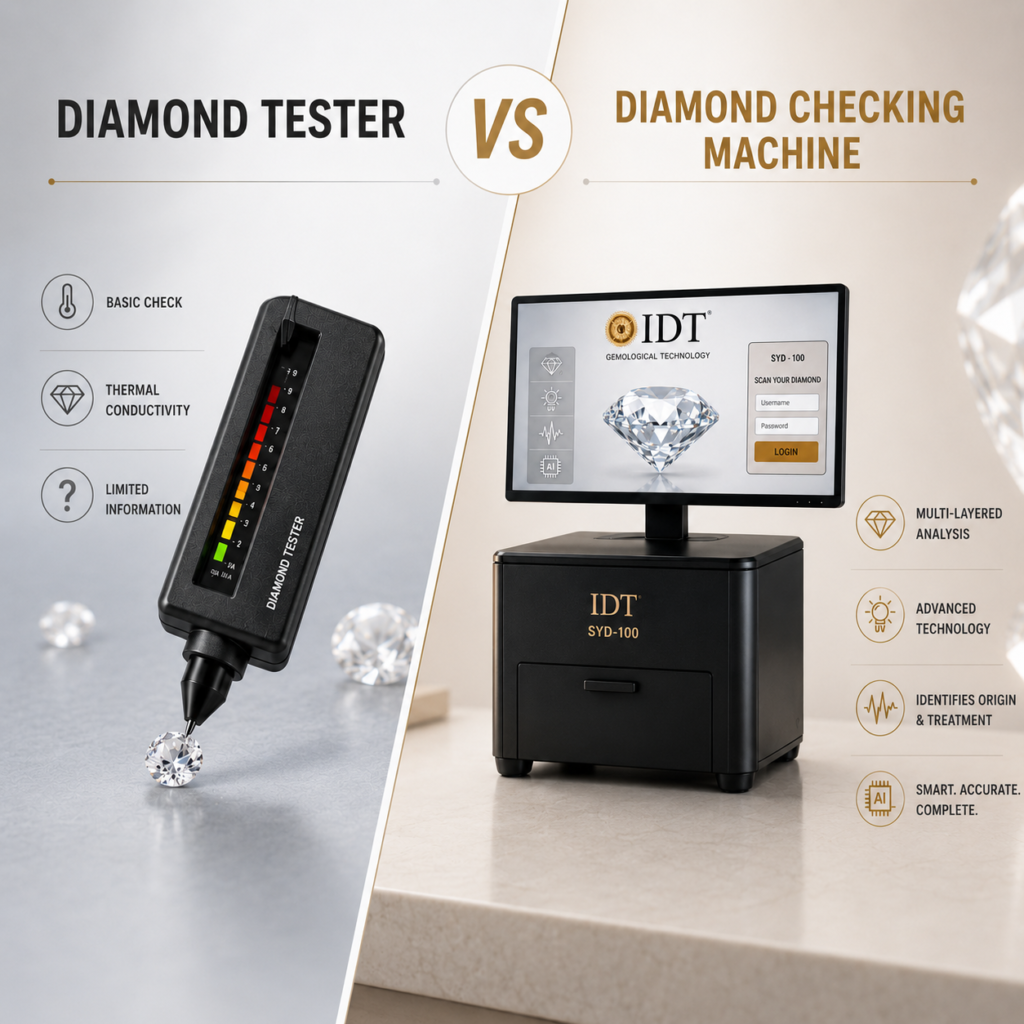
If You’re Still Relying Only on a Diamond Tester, You’re Taking a Risk Every jeweller has faced this situation. A customer brings in a diamond ring for exchange. A supplier offers a parcel of diamonds. A manufacturer receives stones for a production order. A Polki necklace arrives for valuation. The diamonds appear genuine. The supplier may be trusted. The paperwork may look correct. But one question remains: How do you check diamond purity before it hits your inventory? In 2026, IDT labs screened over 2.1 million stones. Approximately 12% of parcels represented as natural diamonds contained at least one lab-grown diamond. That risk is why jewellery businesses worldwide are moving beyond traditional diamond testers and investing in advanced diamond checking machines. In today’s market, identifying natural diamonds, laboratory-grown diamonds, HPHT-treated diamonds, and simulants requires more than visual inspection or basic testing methods. Modern diamond screening technology helps jewellers make informed decisions before costly mistakes occur. What Is a Diamond Checking Machine? A diamond checking machine is an advanced screening device used to verify and analyse diamonds before they enter inventory, manufacturing, valuation, or retail sale. Unlike basic diamond testers, modern diamond checking machines help identify: For jewellers, wholesalers, manufacturers, and exporters, a diamond checking machine has become an essential quality control tool. Diamond Tester vs Diamond Checking Machine One of the biggest misconceptions in the jewellery industry is that a diamond tester and a diamond checking machine perform the same job. They do not. What Does a Diamond Tester Do? A traditional diamond tester checks whether a stone exhibits diamond-like thermal properties. This can help determine whether a stone behaves like a diamond. However, laboratory-grown diamonds can often produce similar results. A diamond tester may confirm that a stone is a diamond, but it may not provide sufficient information about its origin or treatment. What Does a Diamond Checking Machine Do? A diamond checking machine goes significantly further. Advanced systems like SYD 100 use optical imaging, Triple UV technology, fluorescence analysis, phosphorescence mapping, and AI-powered algorithms to identify characteristics associated with natural diamonds, laboratory-grown diamonds, treated diamonds, and simulants. For modern jewellery businesses, this additional level of verification is increasingly important. How to Check Diamond Purity in Your Store One of the most common questions consumers and jewellers ask is: How do you check diamond purity? Many people assume that visual inspection is enough. It isn’t. Natural diamonds, laboratory-grown diamonds, and some simulants can appear remarkably similar to the naked eye. Professional verification typically involves a combination of: For businesses handling diamonds regularly, relying solely on traditional methods can create unnecessary risk. This is why professional jewellers increasingly use advanced diamond checking machines as part of their verification process. The Growing Challenge of Lab-Grown Diamonds Laboratory-grown diamonds have become a permanent part of the jewellery industry. When properly disclosed, they are legitimate products. The challenge arises when laboratory-grown diamonds enter inventory without appropriate identification. Real Case from IDT A Mumbai jeweller purchased a 50-point natural melee parcel for a tennis bracelet order. The supplier had a trusted reputation spanning 15 years. Three stones in that parcel were CVD lab-grown diamonds. The jeweller did not detect them. The customer’s appraiser did after the sale. Loss: ₹1.8 lakh refund, making charges, two months of dispute resolution, and a one-star review. Potential consequences include: For jewellers purchasing loose diamonds, parcels, mounted jewellery, or customer trade-ins, screening has become an important first line of defence. An advanced diamond checking machine helps identify stones that may require further examination before they enter inventory. Why HPHT-Treated Diamonds Matter, Especially in Polki Jewellery While most discussions focus on laboratory-grown diamonds, HPHT-treated diamonds present another important challenge. HPHT (High Pressure High Temperature) treatment is used to improve the appearance of certain diamonds. When properly disclosed, treated diamonds are legitimate products. Problems occur when treatment is unknown or undisclosed. This is particularly relevant for jewellers dealing in: Many of these pieces may have changed hands multiple times over the years. Repairs, replacements, treatments, and undocumented modifications can complicate verification. For jewellers working with Polki jewellery, identifying HPHT-treated diamonds can be just as important as identifying laboratory-grown diamonds. CVD diamonds show different fluorescence patterns under Deep UV. SYD 100 flags those patterns. Why Mounted Jewellery Is Harder to Verify Than Loose Diamonds Loose diamonds can be examined individually. Mounted jewellery presents a different challenge. Consider rings, bangles, bracelets, earrings, necklaces, chokers, diamond-studded jewellery, and bridal sets. Testing each stone individually can be impractical and time-consuming. This is why mounted jewellery screening has become one of the fastest-growing requirements within the jewellery trade. Modern jewellery businesses need solutions capable of screening mounted jewellery efficiently without disrupting workflow. Introducing SYD 100: IDT’s AI-Powered Diamond Checking Machine To address these challenges, IDT developed the SYD 100. The SYD (Scan Your Diamond) Machine Series brings laboratory-level diamond verification directly to the trade. Powered by advanced AI and precision spectroscopic screening, the SYD system accurately distinguishes natural, lab-grown, treated, and simulant stones, including moissanite and cubic zirconia, within seconds. Engineered by gemologists and used in IDT labs since 2022, SYD 100 was designed specifically for retailers, manufacturers, wholesalers, and chain stores. It combines advanced optical engineering, Triple UV technology, fluorescence analysis, phosphorescence mapping, and proprietary AI-powered interpretation to help identify diamonds, treatments, and simulants. Unlike equipment designed solely for laboratory environments, SYD 100 was developed for practical use in jewellery retail, manufacturing, quality control, inventory management, and trade operations. What Can SYD 100 Detect? SYD 100 is designed to screen: This makes it a valuable tool for jewellers seeking greater confidence in inventory verification and purchasing decisions. How SYD 100 Works Advanced Optical Imaging SYD 100 uses high-resolution autofocus imaging and advanced optics to analyse diamonds and mounted jewellery consistently. Triple UV Technology The system evaluates stones using Short-Wave UV, Long-Wave UV, and Deep UV. These wavelengths help analyse fluorescence and phosphorescence characteristics associated with natural diamonds, laboratory-grown diamonds, and treated diamonds. AI-Powered Analysis Proprietary algorithms analyse multiple parameters simultaneously to identify patterns associated