SYD 100 Diamond Testing Machine: Laboratory-Grade Diamond Detection for the Jewellery Trade
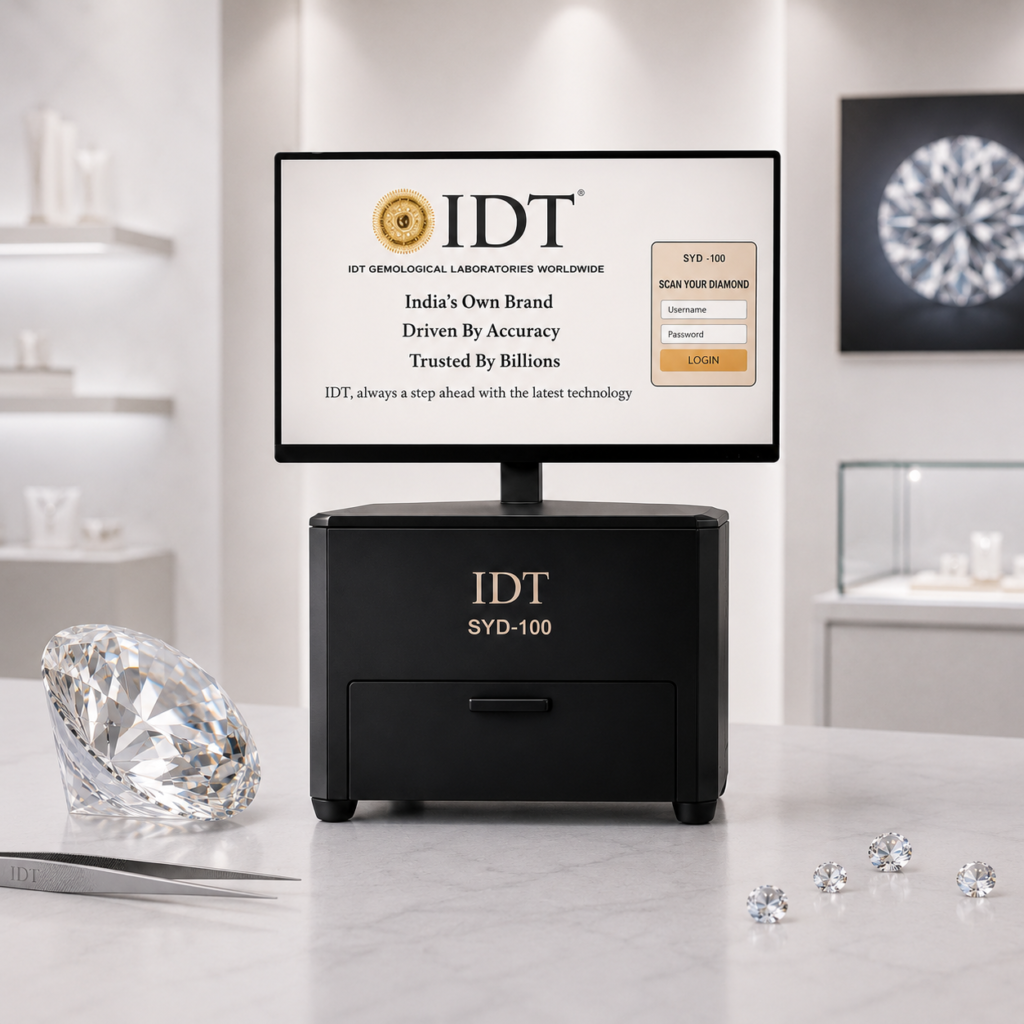
The diamond industry is evolving rapidly. Natural diamonds, laboratory-grown diamonds, treated stones, moissanite, zircon, and other simulants can often appear visually similar. For jewellers, manufacturers, wholesalers, and quality-control teams, identifying these stones accurately is essential. A basic handheld diamond tester may provide an initial indication, but today’s jewellery businesses require a more advanced and dependable solution. The SYD 100 Diamond Testing Machine, developed by IDT Gemological Laboratories, brings laboratory-grade diamond authentication technology into everyday jewellery environments. It provides fast and decisive identification of natural diamonds, lab-grown diamonds, treated stones, and simulants, whether they are loose, polished, or mounted in jewellery. What Is the SYD 100 Diamond Testing Machine? The SYD 100 is IDT’s proprietary diamond testing machine, designed for large jewellery articles and high-volume diamond screening. It combines advanced optical engineering, multiple UV fluorescence evaluation, AI-assisted interpretation, and IDT’s gemological expertise to provide consistent and trade-ready results. Unlike a conventional diamond tester that may only help distinguish a diamond from certain simulants, the SYD 100 examines multiple characteristics of a stone. This enables the machine to identify a wider spectrum of materials and treatments. The SYD 100 is suitable for testing: Every result reflects IDT’s scientific standards, helping jewellery businesses make informed decisions with greater confidence. Why Does the Jewellery Industry Need an Advanced Diamond Detector? The growing availability of laboratory-grown diamonds and highly convincing diamond simulants has made visual identification increasingly difficult. A stone may look like a natural diamond but could be laboratory-grown, treated, or even a simulant. Mounted jewellery can create an additional challenge because stones cannot always be removed for individual testing. This is where an advanced diamond detector such as the SYD 100 becomes important. The machine helps jewellery professionals screen stones before they are purchased, manufactured, sold, exchanged, or accepted for quality control. It brings scientific verification directly into jewellery stores, manufacturing units, wholesale offices, and quality-control departments. Reliable Jewellery Buy-Back and Resale Evaluation Buy-back, exchange, and resale are important parts of a jeweller’s business. Before accepting previously owned jewellery, jewellers need clarity on whether the stones are natural, laboratory-grown, treated, or simulants. The SYD 100 enables quick screening of mounted jewellery during buy-back and resale evaluation. This helps jewellers reduce the risk of accepting incorrectly represented stones, make better-informed valuation decisions, and conduct transactions with greater confidence. It also helps jewellers build customer trust by offering greater transparency and assurance during buy-back, exchange, and resale transactions. Customers feel more confident knowing that their jewellery has been checked using advanced diamond authentication technology. What Can the SYD 100 Identify? The SYD 100 offers a complete diamond authentication spectrum for the modern jewellery trade. Natural Diamonds The machine evaluates the stone’s optical and fluorescence behaviour to help identify natural diamonds accurately. Laboratory-Grown Diamonds The SYD 100 detects laboratory-grown diamonds created through both major production methods: This helps reduce the risk of laboratory-grown diamonds being unknowingly mixed with natural diamond parcels or jewellery. HPHT-Treated Diamonds Certain diamonds undergo HPHT treatment to improve or alter their appearance. The SYD 100 supports the identification of such treated stones, providing important information beyond basic diamond detection. Moissanite and Zircon Moissanite and zircon can resemble diamonds, especially to an untrained eye. The SYD 100 helps separate these simulants from natural and laboratory-grown diamonds. Mounted Jewellery One of the major advantages of the SYD 100 is its ability to screen diamonds without requiring them to be removed from the jewellery. It can accommodate large articles such as: Loose and Polished Stones The system can also be used for loose and polished diamonds, making it suitable for manufacturers, traders, wholesalers, and quality-control teams handling diamond parcels. Key Features of the SYD 100 Large Scanning Area The SYD 100 has a scanning area of 260 x 160 mm, allowing users to test large jewellery pieces and multiple stones efficiently. Its spacious testing chamber is particularly useful for necklace sets, chokers, bangles, bracelets, and high-volume loose-stone screening. Capacity of Up to 100 Carats The machine is designed to accommodate loose stones and jewellery articles with a combined capacity of up to 100 carats, making it suitable for businesses handling large quantities of diamonds. 60-Second Detection Cycles Time is critical in busy jewellery environments. The SYD 100 delivers fast detection cycles of approximately 60 seconds, helping businesses screen more articles without disrupting their workflow. AI-Assisted Interpretation AI-supported decisioning helps provide consistent and objective interpretation across different users and business locations. This reduces dependence on individual judgement and makes the testing process more standardised. Advanced Optical Engineering The machine uses advanced optical engineering to evaluate the behaviour and characteristics of stones that may not be visible through ordinary observation. Triple-UV and Fluorescence Science The SYD 100 uses multi-UV and fluorescence-based evaluation to study how stones react under different testing conditions. These reactions provide valuable information for separating natural diamonds, laboratory-grown diamonds, treated stones, and simulants. Compact, Trade-Ready Design Despite its high testing capacity, the SYD 100 is designed for real-world jewellery environments. Its dimensions are: 405 x 365 x 330 mm This allows the machine to be installed in manufacturing units, jewellery stores, wholesale offices, and dedicated quality-control areas. SYD 100 vs a Basic Handheld Diamond Tester A handheld diamond tester is commonly used to check whether a stone has certain thermal or electrical properties associated with diamonds. However, such devices may have limitations when testing laboratory-grown diamonds, treated stones, or mounted jewellery. The SYD 100 offers a more comprehensive approach. SYD 100 Diamond Testing Machine Basic Diamond Tester Designed for advanced diamond authentication Mainly used for preliminary screening Separates natural, lab-grown, treated, and simulant stones May distinguish diamonds from some simulants Screens large jewellery articles and multiple stones Usually tests one stone at a time AI-supported and objective interpretation Results may depend on probe placement Suitable for mounted and loose stones Limited application for mounted jewellery Uses optical, UV, fluorescence, and AI-based evaluation Primarily checks thermal or electrical behaviour For jewellery businesses, the SYD 100 is not simply a diamond tester. It is a
What Is a Diamond Certificate? A Beginner’s Complete Guide
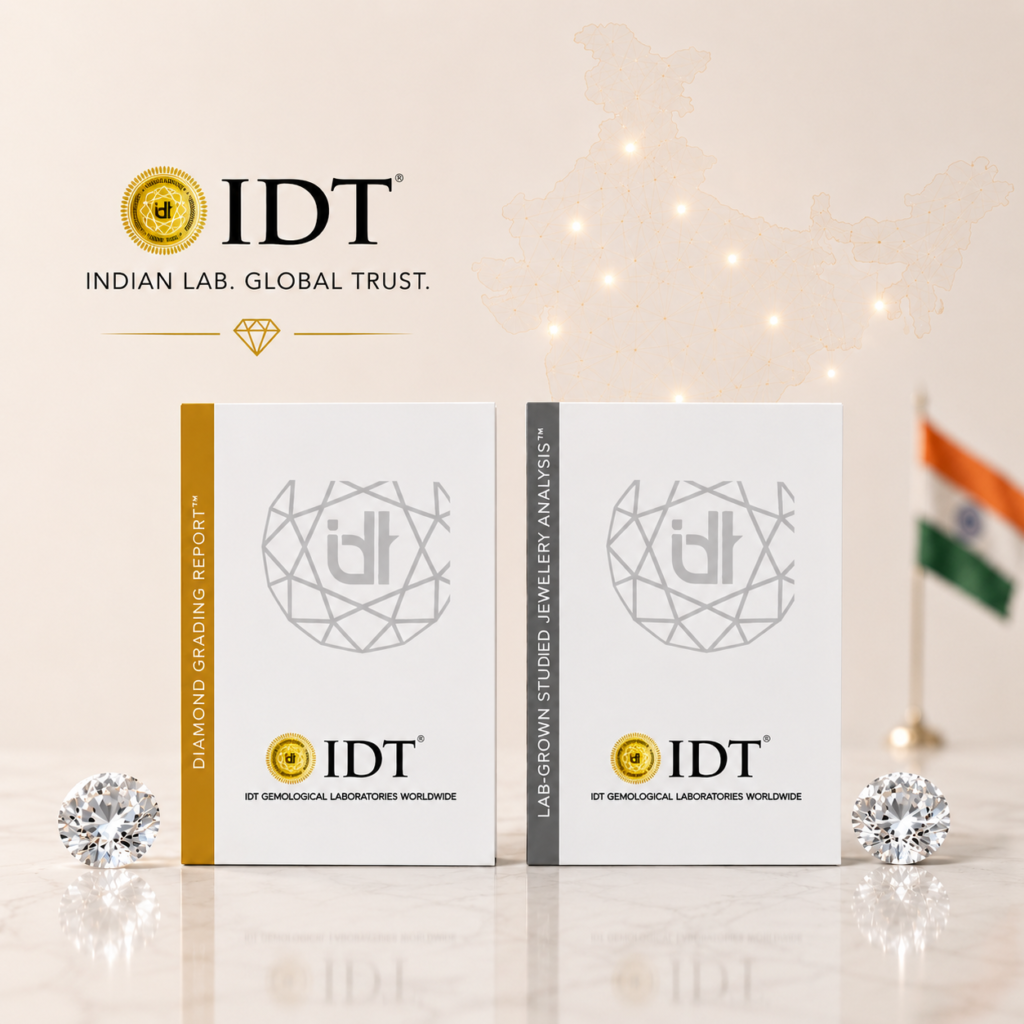
Buying a diamond is one of life’s most meaningful purchases. A diamond certificate, also called a diamond grading report, is the single document that tells you exactly what you’re getting. Here’s everything you need to know before you buy. Whether you’re shopping for an engagement ring, a gift, or an investment stone, you’ve almost certainly heard the phrase “certified diamond.” But what does that actually mean? What does a diamond certificate contain, who issues it, and why does diamond certification in India matter so much in today’s market? At IDT Gemological Laboratories, we’ve assessed and certified thousands of diamonds across India. In this complete beginner’s guide, we break down everything simply, so you can shop with total confidence. What Is a Diamond Certificate? A diamond certificate, officially called a diamond grading report, is an official document issued by an independent gemological laboratory after a thorough scientific examination of a diamond. Think of it as the diamond’s identity card, an unbiased, third party verification of its quality. The certificate does not assign a monetary value to the diamond. Instead, it objectively describes the stone’s physical and optical characteristics using internationally recognised grading standards. This protects you, the buyer, from overpaying and ensures you receive exactly the diamond quality you’re promised. Key point: A diamond certificate is issued by a laboratory, never by the jeweller selling the stone. This independence is what makes the document trustworthy. Always look for a certificate from IDT Gemological Laboratories before making any diamond purchase. What Does a Diamond Grading Report Include? A comprehensive diamond grading report from IDT Gemological Laboratories covers all the characteristics that determine a diamond’s quality and value. Here is what you’ll find: Cut Grades how well the diamond has been faceted and finished, directly determining its brilliance and fire. Ranges from Excellent to Poor. Colour Measures the absence of colour on a D (colourless) to Z (light yellow/brown) scale. The less colour, the rarer and more valuable the stone. Clarity Evaluates internal inclusions and surface blemishes under 10× magnification. Ranges from Flawless (FL) to Included (I3). Carat Weight The precise weight of the diamond, measured to the nearest hundredth of a carat. Directly impacts value alongside the other three Cs. Beyond the 4Cs, a complete IDT diamond grading report also includes: ● Diamond shape and cutting style (e.g. Round Brilliant, Princess, Oval) ● Measurements, precise dimensions in millimetres ● Polish and symmetry grades ● Fluorescence (whether the stone glows under UV light and its intensity) ● A plotting diagram showing the exact location of inclusions ● A unique certificate number for verification ● Security features to prevent forgery Why Is Diamond Certification Important? Without a diamond certificate, you’re essentially taking the seller’s word for the quality of your stone. That’s a significant risk, especially given that two diamonds that look nearly identical to the naked eye can differ enormously in value based on their grading. Here’s what diamond certification protects you from: Misrepresentation A seller may describe a diamond as “VS1 clarity” when it’s actually SI2. A certificate removes all ambiguity. Synthetic or Treated Stones Certified labs test for synthetic diamonds and treatments like laser drilling or fracture filling. Price Manipulation With a grading report in hand, you can accurately compare prices across jewellers and ensure you’re paying a fair market rate. Resale and Insurance Problems Certified diamonds are far easier to insure and resell, as their characteristics are documented by an independent authority. Diamond Certification in India: What You Need to Know India is the world’s largest diamond cutting and polishing hub. Over 90% of the world’s diamonds are processed in Surat alone. This makes access to credible diamond certification in India not just important, but essential. As Indian consumers become more sophisticated, demand for independently certified diamonds has surged. Buyers in cities like Mumbai, Delhi, Surat, Chennai, and Hyderabad increasingly insist on seeing a diamond grading report before purchase, and rightfully so. IDT Gemological Laboratories is one of India’s premier diamond certification bodies, combining internationally aligned grading methodology with deep local expertise. Our reports are recognised and trusted by jewellers, traders, and consumers across the country. When you see an IDT certificate, you can buy with complete confidence. How to Read a Diamond Certificate Receiving a diamond certificate for the first time can feel overwhelming. Here’s a simple walkthrough of how to read an IDT diamond grading report: Section on the Certificate What It Tells You What to Look For Report Number Unique ID for the certificate Verify online at IDT’s portal Shape & Style The diamond’s shape Round Brilliant = most brilliant Measurements Dimensions in mm Confirms size matches listing Carat Weight Exact weight Cross check with seller’s claims Colour Grade D to Z colour scale D to F = colourless, most valuable Clarity Grade FL to I3 inclusion scale VS1 to VS2 = excellent value sweet spot Cut Grade Excellent to Poor Prioritise Excellent or Very Good Polish & Symmetry Finishing quality Excellent / Very Good = best Fluorescence UV glow intensity None to Faint preferred for most buyers Clarity Plot Map of inclusions Fewer markings = cleaner stone Certified vs. Uncertified Diamonds You may encounter uncertified diamonds priced attractively lower than certified stones. Here’s why that discount rarely benefits you: ● You cannot independently verify the quality claims made by the seller ● Resale value is significantly lower without documentation ● Insurance providers often require certification for high value stones ● The risk of purchasing a synthetic, treated, or misrepresented stone is substantially higher The small premium paid for a certified diamond is almost always recovered in peace of mind, accurate pricing, and resale value. Always ask for the IDT diamond grading report. Frequently Asked Questions Is a diamond certificate the same as a diamond appraisal? No. A diamond certificate, or grading report, objectively describes the diamond’s quality characteristics. An appraisal assigns a monetary value, often for insurance purposes. You typically need both, the certificate first, then an appraisal based on it. Can I get an
Natural vs Lab Grown Diamond: What’s the Difference?
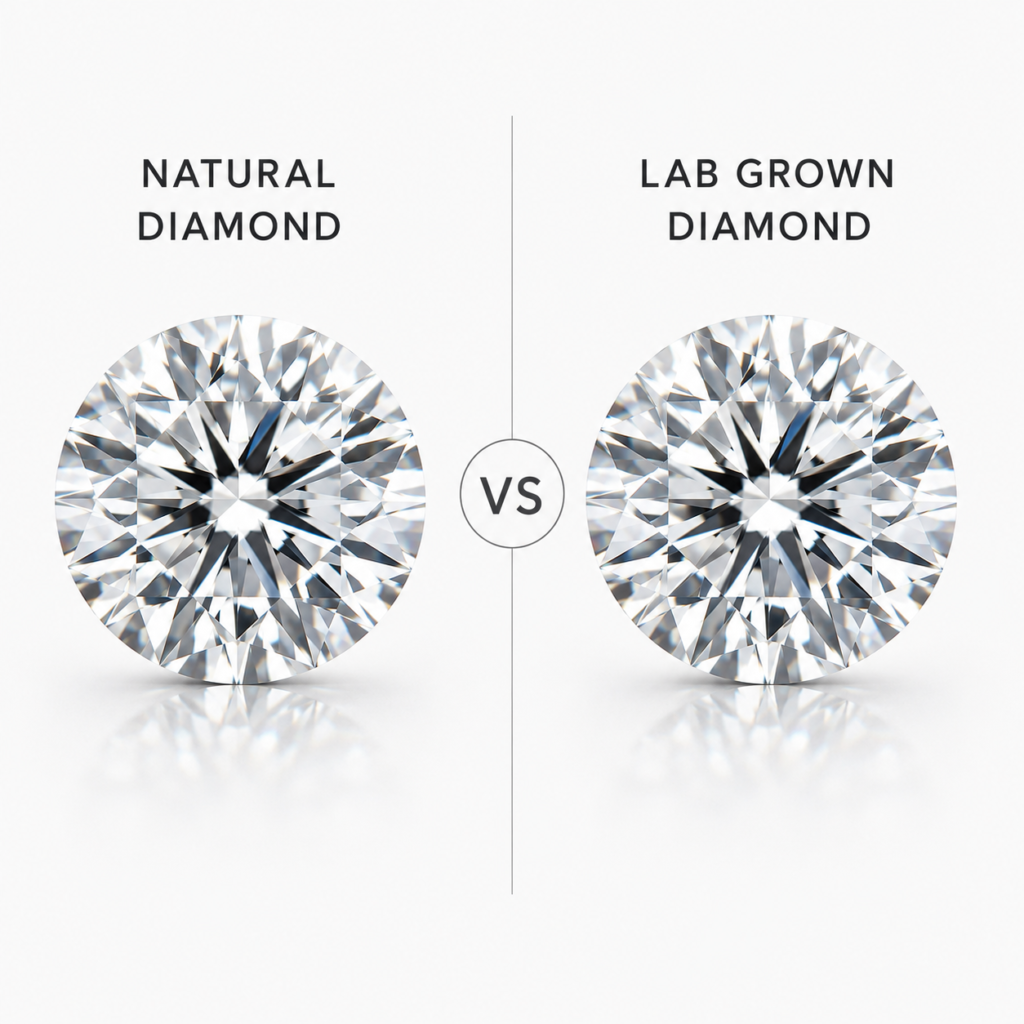
The diamond industry has evolved rapidly over the past decade. Today, buyers can choose between natural diamonds formed beneath the Earth over billions of years and lab grown diamonds created using advanced technology within weeks. As both categories are now widely available across jewellery stores and online platforms, many consumers want to understand how they compare. While both are genuine diamonds with similar physical properties, their origin and formation process are different. This guide explains the key comparisons between natural and lab grown diamonds, including formation, grading, identification, and certification. Natural vs Lab Grown Diamond: Quick Comparison How Natural Diamonds Are Formed Natural diamonds are formed deep within the Earth under extreme heat and pressure over billions of years.They are later brought closer to the surface through volcanic activity and eventually extracted from diamond-bearing deposits. Because of their natural geological origin, each diamond develops unique internal growth characteristics over time How Lab Grown Diamonds Are Made Lab grown diamonds are created using advanced technological processes that replicate the conditions under which diamonds naturally form. Unlike natural diamonds, which take billions of years to develop, lab grown diamonds can be produced within weeks. Two major methods are commonly used: HPHT (High Pressure High Temperature) HPHT technology recreates the pressure and temperature conditions found deep within the Earth’s mantle, allowing carbon atoms to crystallise into a diamond. CVD (Chemical Vapour Deposition) CVD diamonds are grown inside a vacuum chamber using carbon-rich gases, where carbon atoms gradually deposit layer by layer onto a diamond seed crystal. Natural and Lab Grown Diamonds: Key Comparisons Origin Natural diamonds are formed naturally within the Earth, while lab grown diamonds are produced in controlled laboratory environments. Physical Properties Both natural and lab grown diamonds: To the naked eye, they are usually visually indistinguishable. Growth Characteristics Natural diamonds often contain naturally occurring inclusions and irregular growth patterns. Lab grown diamonds may display layered growth structures or characteristics related to their manufacturing process. Identification Reliable identification requires advanced gemological testing and laboratory analysis. Professional testing helps determine the diamond’s origin accurately. Certification, Grading & Origin Disclosure Both natural and lab grown diamonds are graded using the traditional 4Cs standards: Because natural and lab grown diamonds can appear visually similar, clear origin disclosure on the grading report is extremely important. A diamond grading report should clearly mention whether the diamond is: Certification helps provide transparency and confidence during diamond purchases by documenting important grading information such as: IDT Certification: Diamond Origin Clearly Stated An IDT grading report clearly states the diamond’s origin along with its grading information, helping buyers better understand the diamond they are purchasing. Clear origin disclosure supports transparency and informed diamond buying decisions. Which Diamond Is Right for You? The choice between natural and lab grown diamonds depends on individual preference and purchasing priorities. Regardless of preference, buyers should ensure their diamond is accompanied by a grading report from a reputable gemological laboratory that clearly states the diamond’s origin. Frequently Asked Questions Can you tell a lab grown diamond from a natural diamond by looking at it? No. Accurate identification usually requires professional gemological testing. Why is IDT certification important? An IDT Gemological Laboratories grading report clearly discloses whether a diamond is natural or laboratory grown, along with its grading information. Do lab grown diamonds have the same hardness as natural diamonds? Yes. Both rank 10 on the Mohs hardness scale. Why is origin disclosure important? Origin disclosure helps ensure transparency in diamond transactions. Is certification important for both natural and lab grown diamonds? Yes. Certification provides documented grading information and clear origin disclosure for both categories of diamonds.