
If You’re Still Relying Only on a Diamond Tester, You’re Taking a Risk
Every jeweller has faced this situation.
A customer brings in a diamond ring for exchange.
A supplier offers a parcel of diamonds.
A manufacturer receives stones for a production order.
A Polki necklace arrives for valuation.
The diamonds appear genuine. The supplier may be trusted. The paperwork may look correct.
But one question remains:
How do you check diamond purity before it hits your inventory?
In 2026, IDT labs screened over 2.1 million stones. Approximately 12% of parcels represented as natural diamonds contained at least one lab-grown diamond. That risk is why jewellery businesses worldwide are moving beyond traditional diamond testers and investing in advanced diamond checking machines.
In today’s market, identifying natural diamonds, laboratory-grown diamonds, HPHT-treated diamonds, and simulants requires more than visual inspection or basic testing methods.
Modern diamond screening technology helps jewellers make informed decisions before costly mistakes occur.
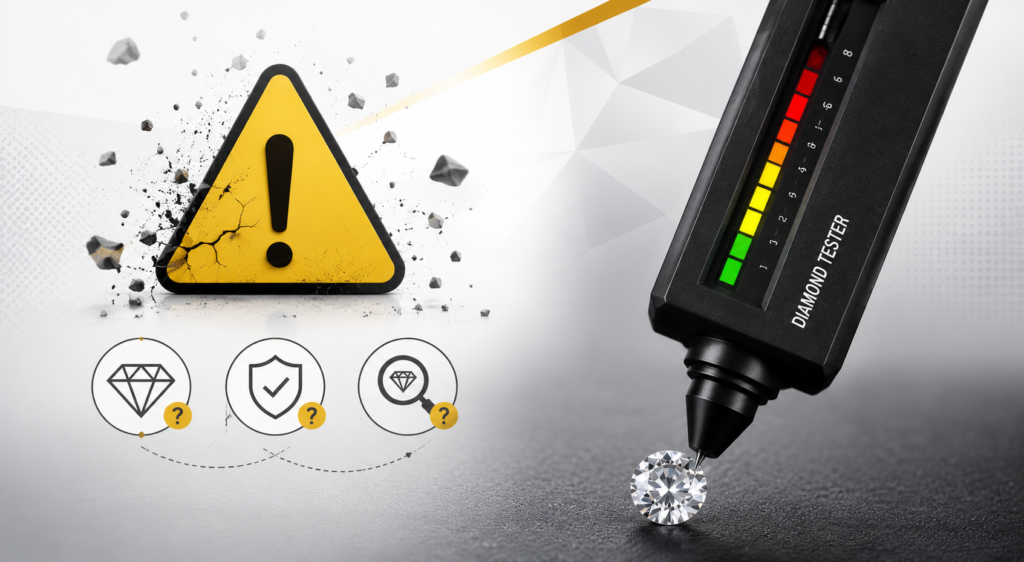
What Is a Diamond Checking Machine?
A diamond checking machine is an advanced screening device used to verify and analyse diamonds before they enter inventory, manufacturing, valuation, or retail sale.
Unlike basic diamond testers, modern diamond checking machines help identify:
- Natural Diamonds
- Laboratory-Grown Diamonds
- CVD Diamonds
- HPHT-Grown Diamonds
- HPHT-Treated Diamonds
- Moissanite
- Cubic Zirconia
- Other Diamond Simulants
- Loose Diamonds
- Mounted Jewellery
For jewellers, wholesalers, manufacturers, and exporters, a diamond checking machine has become an essential quality control tool.
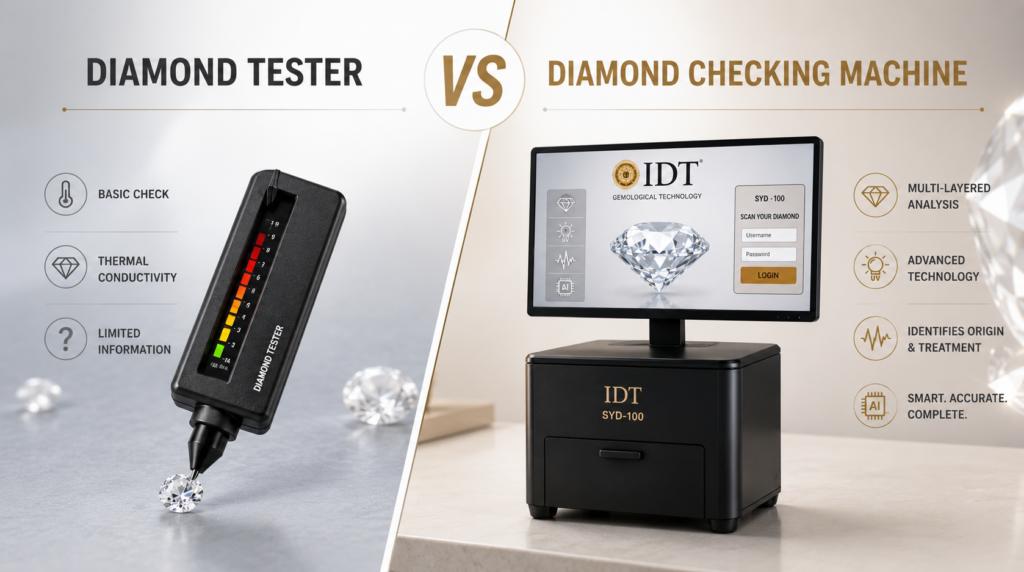
Diamond Tester vs Diamond Checking Machine
One of the biggest misconceptions in the jewellery industry is that a diamond tester and a diamond checking machine perform the same job.
They do not.
What Does a Diamond Tester Do?
A traditional diamond tester checks whether a stone exhibits diamond-like thermal properties. This can help determine whether a stone behaves like a diamond. However, laboratory-grown diamonds can often produce similar results.
A diamond tester may confirm that a stone is a diamond, but it may not provide sufficient information about its origin or treatment.
What Does a Diamond Checking Machine Do?
A diamond checking machine goes significantly further.
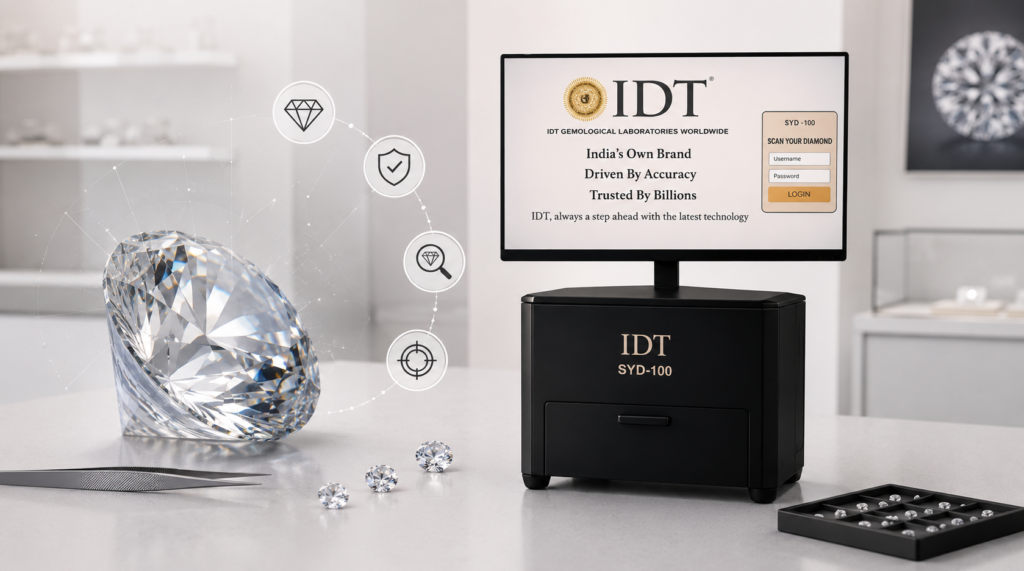
Advanced systems like SYD 100 use optical imaging, Triple UV technology, fluorescence analysis, phosphorescence mapping, and AI-powered algorithms to identify characteristics associated with natural diamonds, laboratory-grown diamonds, treated diamonds, and simulants.
For modern jewellery businesses, this additional level of verification is increasingly important.
How to Check Diamond Purity in Your Store
One of the most common questions consumers and jewellers ask is: How do you check diamond purity?
Many people assume that visual inspection is enough. It isn’t.
Natural diamonds, laboratory-grown diamonds, and some simulants can appear remarkably similar to the naked eye.
Professional verification typically involves a combination of:
- Visual examination
- Optical analysis
- UV analysis
- Fluorescence testing
- Advanced screening technology
- Laboratory testing where required
For businesses handling diamonds regularly, relying solely on traditional methods can create unnecessary risk. This is why professional jewellers increasingly use advanced diamond checking machines as part of their verification process.

The Growing Challenge of Lab-Grown Diamonds
Laboratory-grown diamonds have become a permanent part of the jewellery industry. When properly disclosed, they are legitimate products.
The challenge arises when laboratory-grown diamonds enter inventory without appropriate identification.
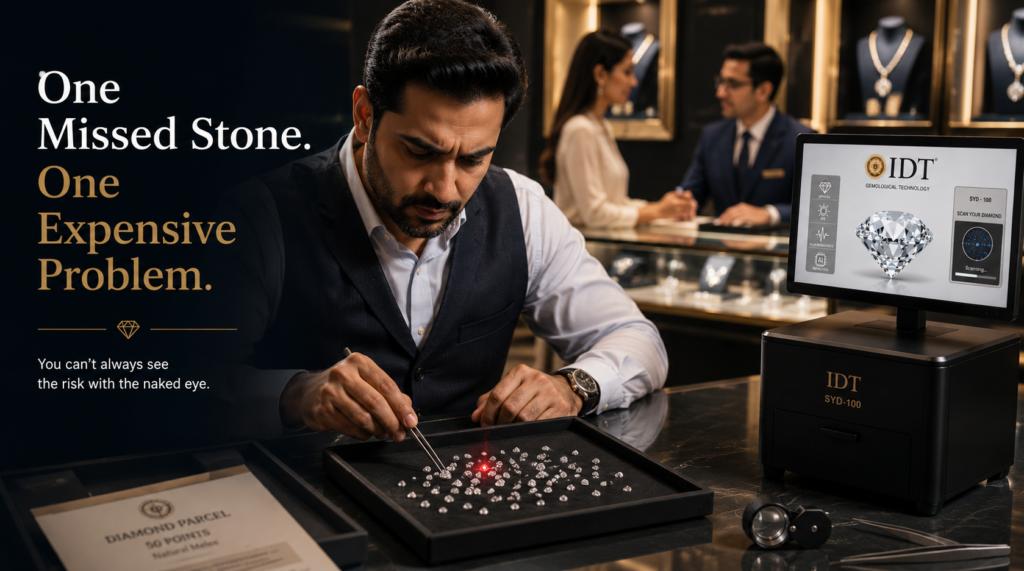
Real Case from IDT
A Mumbai jeweller purchased a 50-point natural melee parcel for a tennis bracelet order. The supplier had a trusted reputation spanning 15 years.
Three stones in that parcel were CVD lab-grown diamonds.
The jeweller did not detect them. The customer’s appraiser did after the sale.
Loss: ₹1.8 lakh refund, making charges, two months of dispute resolution, and a one-star review.
Potential consequences include:
- Incorrect pricing
- Inventory discrepancies
- Customer disputes
- Exchange complications
- Loss of trust
- Reputational damage
For jewellers purchasing loose diamonds, parcels, mounted jewellery, or customer trade-ins, screening has become an important first line of defence.
An advanced diamond checking machine helps identify stones that may require further examination before they enter inventory.
Why HPHT-Treated Diamonds Matter, Especially in Polki Jewellery
While most discussions focus on laboratory-grown diamonds, HPHT-treated diamonds present another important challenge.
HPHT (High Pressure High Temperature) treatment is used to improve the appearance of certain diamonds. When properly disclosed, treated diamonds are legitimate products.
Problems occur when treatment is unknown or undisclosed.
This is particularly relevant for jewellers dealing in:
- Polki jewellery
- Jadau jewellery
- Estate jewellery
- Heritage jewellery
- Bridal jewellery
- Old inventory acquisitions
Many of these pieces may have changed hands multiple times over the years. Repairs, replacements, treatments, and undocumented modifications can complicate verification.
For jewellers working with Polki jewellery, identifying HPHT-treated diamonds can be just as important as identifying laboratory-grown diamonds.
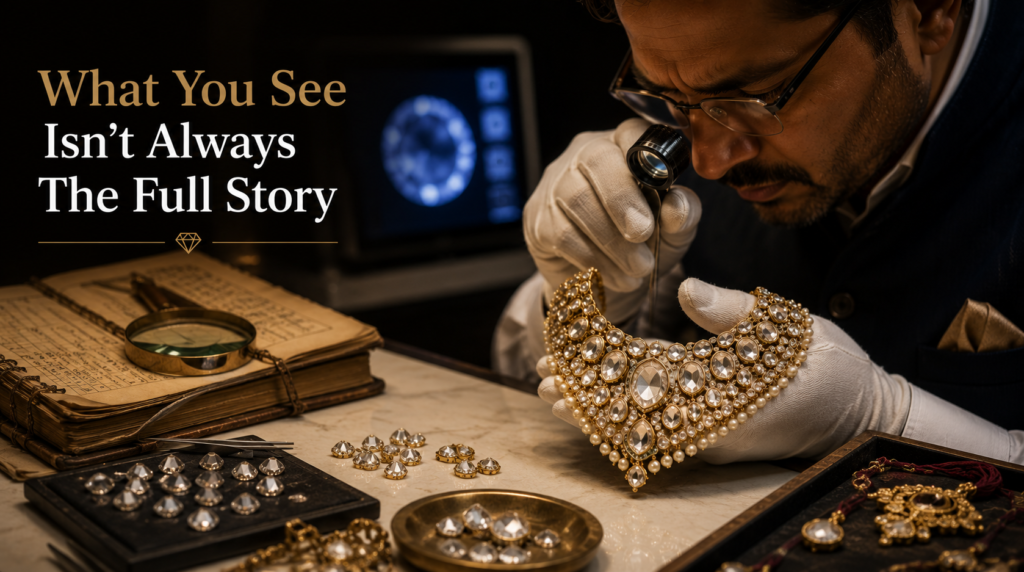
CVD diamonds show different fluorescence patterns under Deep UV. SYD 100 flags those patterns.
Why Mounted Jewellery Is Harder to Verify Than Loose Diamonds
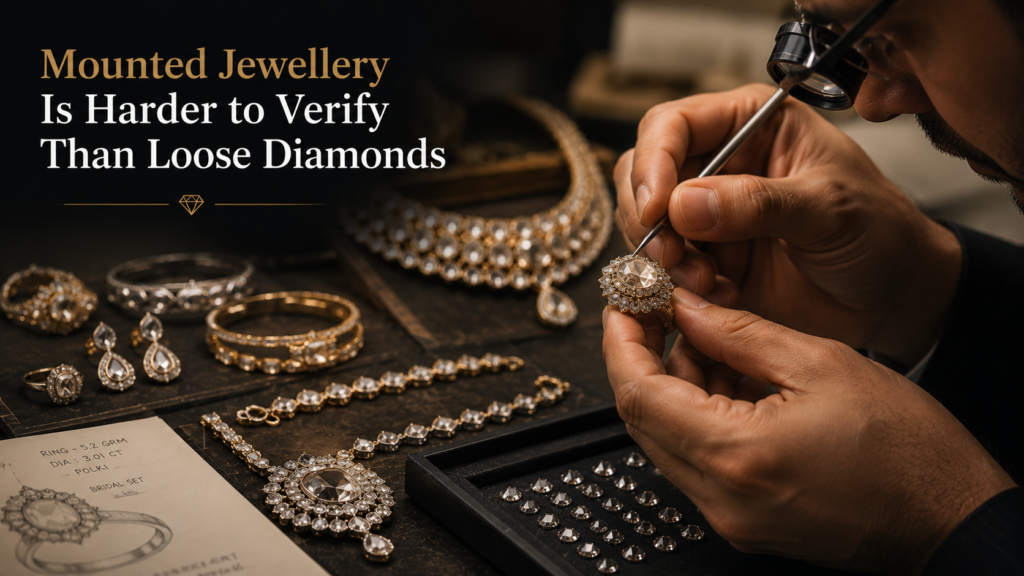
Loose diamonds can be examined individually.
Mounted jewellery presents a different challenge.
Consider rings, bangles, bracelets, earrings, necklaces, chokers, diamond-studded jewellery, and bridal sets.
Testing each stone individually can be impractical and time-consuming.
This is why mounted jewellery screening has become one of the fastest-growing requirements within the jewellery trade.
Modern jewellery businesses need solutions capable of screening mounted jewellery efficiently without disrupting workflow.
Introducing SYD 100: IDT’s AI-Powered Diamond Checking Machine
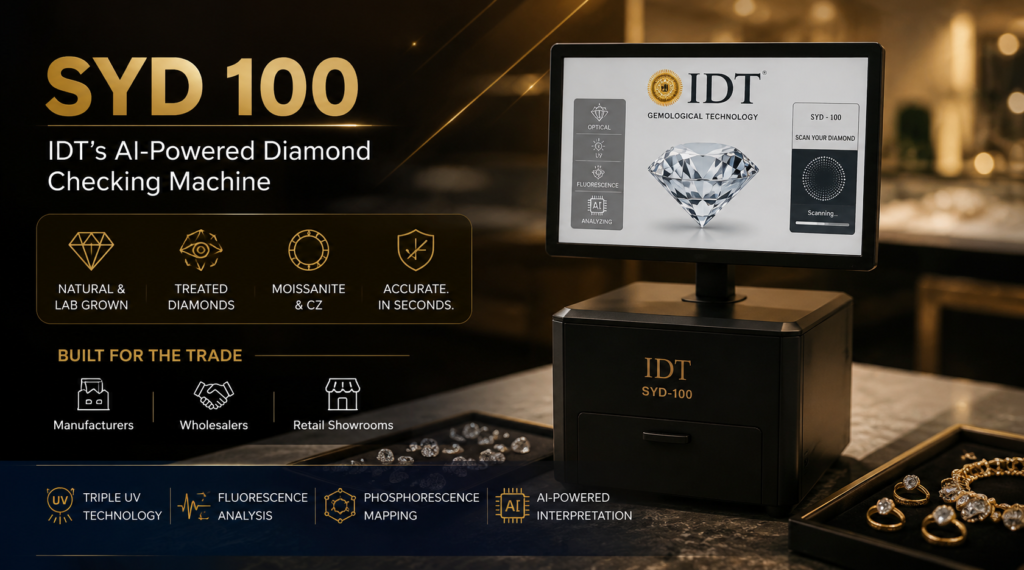
To address these challenges, IDT developed the SYD 100.
The SYD (Scan Your Diamond) Machine Series brings laboratory-level diamond verification directly to the trade.
Powered by advanced AI and precision spectroscopic screening, the SYD system accurately distinguishes natural, lab-grown, treated, and simulant stones, including moissanite and cubic zirconia, within seconds.
Engineered by gemologists and used in IDT labs since 2022, SYD 100 was designed specifically for retailers, manufacturers, wholesalers, and chain stores.
It combines advanced optical engineering, Triple UV technology, fluorescence analysis, phosphorescence mapping, and proprietary AI-powered interpretation to help identify diamonds, treatments, and simulants.
Unlike equipment designed solely for laboratory environments, SYD 100 was developed for practical use in jewellery retail, manufacturing, quality control, inventory management, and trade operations.
What Can SYD 100 Detect?
SYD 100 is designed to screen:
- Natural Diamonds
- Laboratory-Grown Diamonds
- CVD Diamonds
- HPHT-Grown Diamonds
- HPHT-Treated Diamonds
- Moissanite
- Cubic Zirconia
- Other Simulants
- Loose Diamonds
- Mounted Jewellery
This makes it a valuable tool for jewellers seeking greater confidence in inventory verification and purchasing decisions.
How SYD 100 Works
Advanced Optical Imaging
SYD 100 uses high-resolution autofocus imaging and advanced optics to analyse diamonds and mounted jewellery consistently.
Triple UV Technology
The system evaluates stones using Short-Wave UV, Long-Wave UV, and Deep UV.
These wavelengths help analyse fluorescence and phosphorescence characteristics associated with natural diamonds, laboratory-grown diamonds, and treated diamonds.
AI-Powered Analysis
Proprietary algorithms analyse multiple parameters simultaneously to identify patterns associated with laboratory growth, treatments, and simulants.
The result is fast, consistent screening designed for real-world jewellery workflows.
SYD vs Sending Stones to a Lab: What’s the Difference?
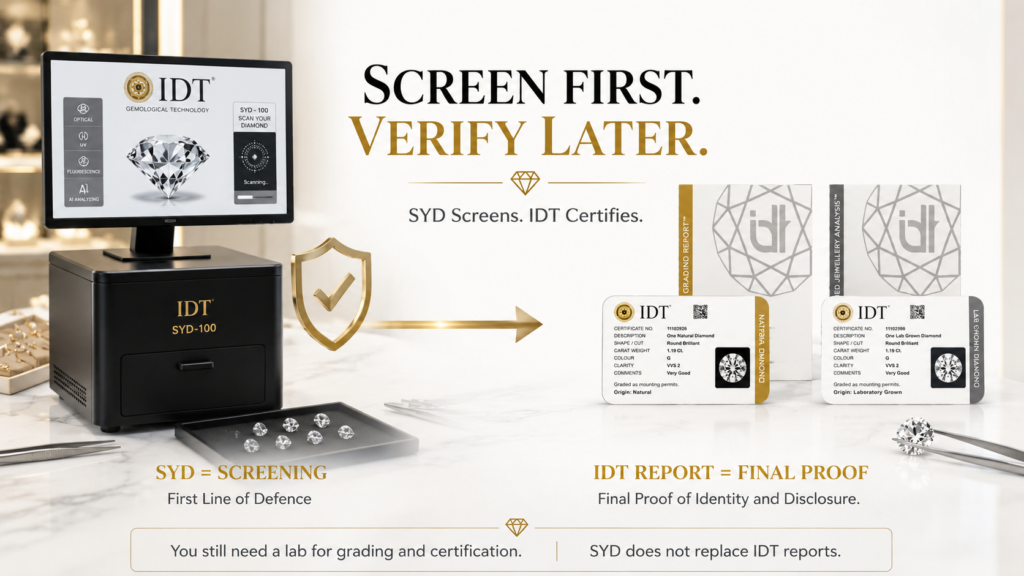
You still need a lab for grading and certification.
SYD does not replace IDT reports.
It protects you before you send stones to the lab.
Think of SYD as your first line of defence.
IDT laboratory reports remain the final proof of identity and disclosure.
Who Should Use a Diamond Checking Machine?
A diamond checking machine can benefit:
- Jewellery Retailers
- Diamond Wholesalers
- Jewellery Manufacturers
- Exporters
- Inventory Managers
- Quality Control Departments
- Valuation Experts
- Businesses Dealing in Polki Jewellery
- Any business handling diamonds regularly can benefit from an additional layer of verification.
Frequently Asked Questions
What is the best way to check diamond purity?
Professional screening and laboratory verification provide the highest level of confidence.
Advanced diamond checking machines like SYD 100 help identify stones that require further examination before they enter inventory.
Can a diamond tester detect lab-grown diamonds?
Traditional diamond testers may not reliably distinguish between natural and laboratory-grown diamonds.
A diamond tester checks thermal properties.
A diamond checking machine like SYD uses spectroscopy to assess origin-related characteristics.
Can SYD 100 identify HPHT-treated diamonds?
Yes.
SYD 100 is designed to help identify HPHT-treated diamonds in addition to laboratory-grown diamonds and simulants.
Can SYD 100 test mounted jewellery?
Yes.
SYD 100 is designed to screen both loose diamonds and mounted jewellery, including Polki, Jadau, and estate pieces, without unmounting.
Why is diamond screening important for Polki jewellery?
Polki jewellery often contains stones with complex histories, repairs, replacements, or treatments.
Screening provides an additional layer of confidence before purchase, valuation, or resale.
Does SYD 100 replace laboratory certification?
No.
Screening identifies stones that may require further examination.
Certification remains important for detailed gemological reporting.
SYD provides Pass or Refer results. Refer stones can then be sent to IDT for full certification.
Is a diamond checking machine accurate?
SYD provides Pass or Refer results.
Accuracy comes from the combination of AI-powered analysis and spectroscopy technology used in IDT laboratories to screen millions of stones.
Can a diamond checking machine test old jewellery?
Yes.
SYD screens mounted Polki, Jadau, estate jewellery, and trade-in pieces without unmounting.
What is the difference between a diamond tester and a CVD detector?
Thermal diamond testers cannot reliably distinguish CVD diamonds from natural diamonds.
Spectroscopy-based diamond checking machines such as SYD 100 can help identify characteristics associated with CVD and HPHT-grown diamonds.
Book a Live SYD 100 Demonstration
The jewellery industry has changed.
Laboratory-grown diamonds are increasingly common.
HPHT-treated diamonds remain a concern.
Mounted jewellery continues to present verification challenges.
A modern diamond checking machine helps jewellers adapt to these realities with greater confidence.
Bring five doubtful stones and we’ll screen them free during your SYD demonstration.
Bring your own diamonds, mounted jewellery, Polki pieces, parcels, or trade-in items and experience SYD 100 in action.
Demo locations available in Delhi, Mumbai, and Dubai.