
Jewellery existed long before diamonds were cut, gold was hallmarked or gemstones were examined in laboratories.
Some of the oldest known personal ornaments date back at least 142,000 years, when early humans used perforated shells as beads. Thousands of years later, civilisations began working with gold, silver, coloured stones and eventually diamonds to create jewellery that represented beauty, power, faith, wealth and identity.
From the bead makers of the Indus Valley and the goldsmiths of ancient Egypt to Mughal jewellery, Victorian designs, Art Deco diamonds and today’s scientifically tested gemstones, the history of jewellery is also a history of human civilisation.
So, how did jewellery evolve from a simple shell into the diamond and gemstone jewellery we recognise today?
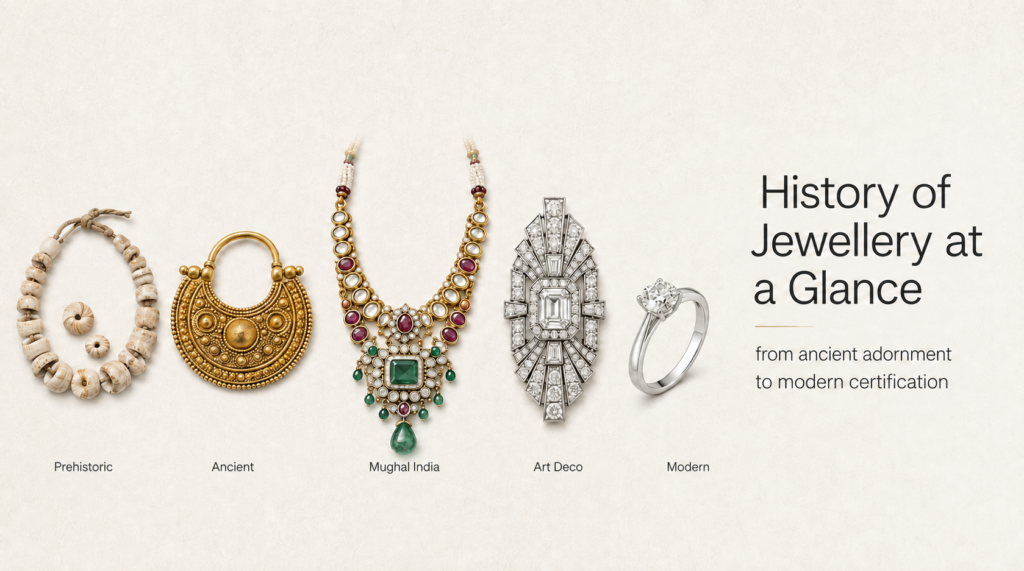
History of Jewellery at a Glance
| Period | Approximate Time | What Changed |
| Prehistoric Jewellery | 142,000+ years ago | Shells, bones and natural materials used as personal ornaments |
| Ancient Civilisations | c. 4000 BCE onwards | Goldworking, gemstones, amulets and elaborate jewellery developed |
| Indus Valley Civilisation | c. 3300 to 1300 BCE | Advanced bead-making, metalwork and stone ornaments flourished |
| Ancient Greece & Rome | c. 800 BCE to 476 CE | Gemstones, cameos, rings and symbolic jewellery became widespread |
| Medieval Period | c. 5th to 15th century | Jewellery reflected religion, rank and social status |
| Renaissance | c. 15th to 17th century | Gemstones, enamel and increasingly elaborate jewellery flourished |
| Mughal India | 16th to 18th century | Gemstones, Kundan, enamel and royal jewellery reached extraordinary levels of craftsmanship |
| Georgian Era | 1714 to 1837 | Handcrafted gold and silver jewellery and increasingly gem-focused designs |
| Victorian Era | 1837 to 1901 | Romantic, symbolic and mourning jewellery evolved with fashion |
| Art Nouveau | c. 1890 to 1910 | Nature-inspired forms and artistic enamel work |
| Edwardian / Belle Époque | c. 1901 to 1915 | Delicate platinum and diamond jewellery |
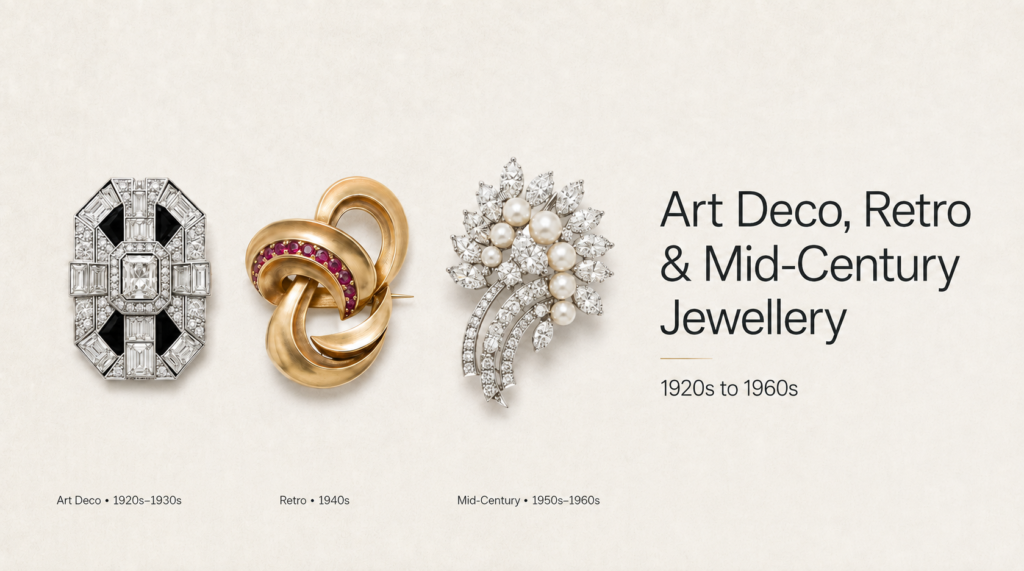
| Art Deco | 1920s to 1930s | Geometric forms, bold contrast and new diamond cuts |
| Retro & Mid-Century | 1940s to 1950s | Bold gold jewellery followed by glamorous post-war designs |
| Contemporary Jewellery | 1960s to present | Technology, global design, laboratory-grown diamonds and gemological certification |
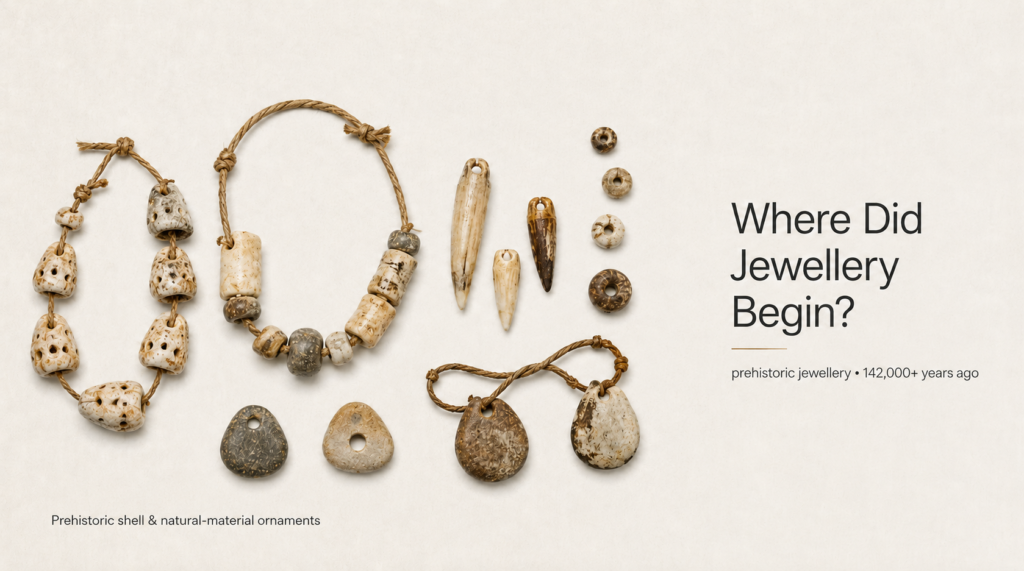
Where Did Jewellery Begin?
The beginning of jewellery takes us much further into the past than most people realise.
Archaeologists discovered perforated marine shells in Bizmoune Cave in Morocco from deposits dating back at least 142,000 years. Researchers believe these shell beads were deliberately worn as ornaments and may have communicated identity or social relationships.
These early ornaments did not contain gold or diamonds.
Humans initially used materials available around them, including:
- Shells
- Bones
- Teeth
- Stones
- Seeds
- Wood
- Animal materials
The purpose of jewellery was probably never purely decorative. Personal ornaments could communicate identity, membership, belief, status or relationships within a community.
This makes jewellery one of humanity’s oldest forms of visual communication.
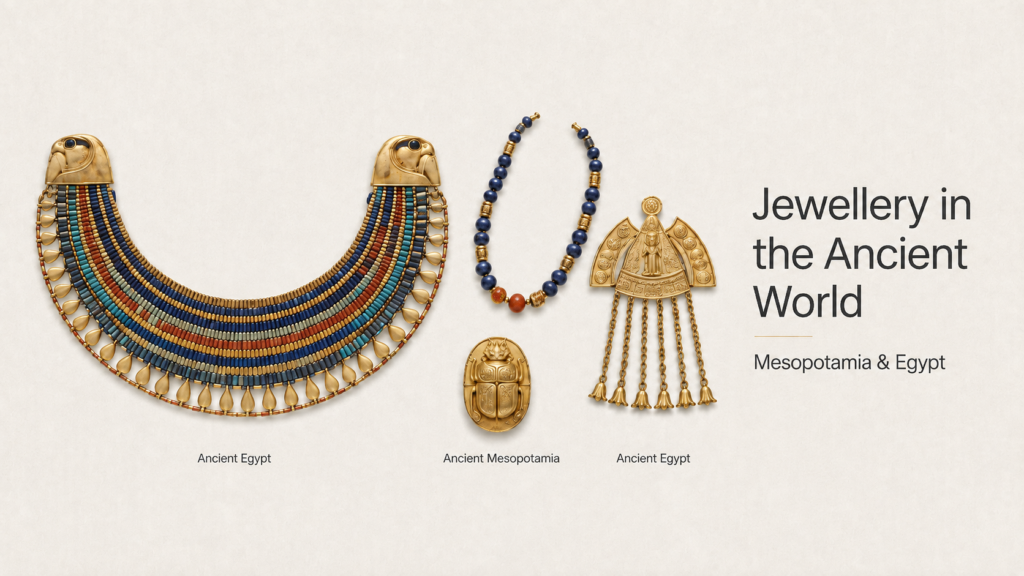
Jewellery in the Ancient World
As settlements grew into organised civilisations, jewellery became increasingly sophisticated.
The discovery and working of metals transformed ornament making. Gold was particularly valued because of its beauty, malleability and resistance to corrosion.
Gemstones added something else: colour.
Jewellery in Ancient Mesopotamia
Some remarkable examples of early gold jewellery have been recovered from ancient Mesopotamia.
Royal burials at Ur, dating to the third millennium BCE, contained elaborate ornaments combining gold with materials such as lapis lazuli and carnelian.
Jewellery was closely linked with power and social standing. Headdresses, necklaces, earrings and other ornaments demonstrated both craftsmanship and access to rare materials arriving through early trade networks.
The jewellery trade was already becoming international.
Jewellery in Ancient Egypt
Few ancient civilisations are associated with jewellery as strongly as Egypt.
Gold was widely used for personal adornment, royal objects, religious pieces and funerary jewellery. Surviving Egyptian gold objects date back to the fourth millennium BCE.
Egyptian jewellery frequently incorporated materials such as:
- Gold
- Lapis lazuli
- Turquoise
- Carnelian
- Amethyst
- Faience
- Coloured glass
But an Egyptian jewel was often more than an ornament.
Scarabs, protective amulets and symbolic motifs could have religious or spiritual meaning. Jewellery was worn in life and was also placed with the deceased.
Colour itself could carry meaning, while access to certain materials demonstrated wealth and social position.
Ancient Egyptian jewellery therefore combined beauty, belief, craftsmanship and status in a way that continues to fascinate jewellers today.
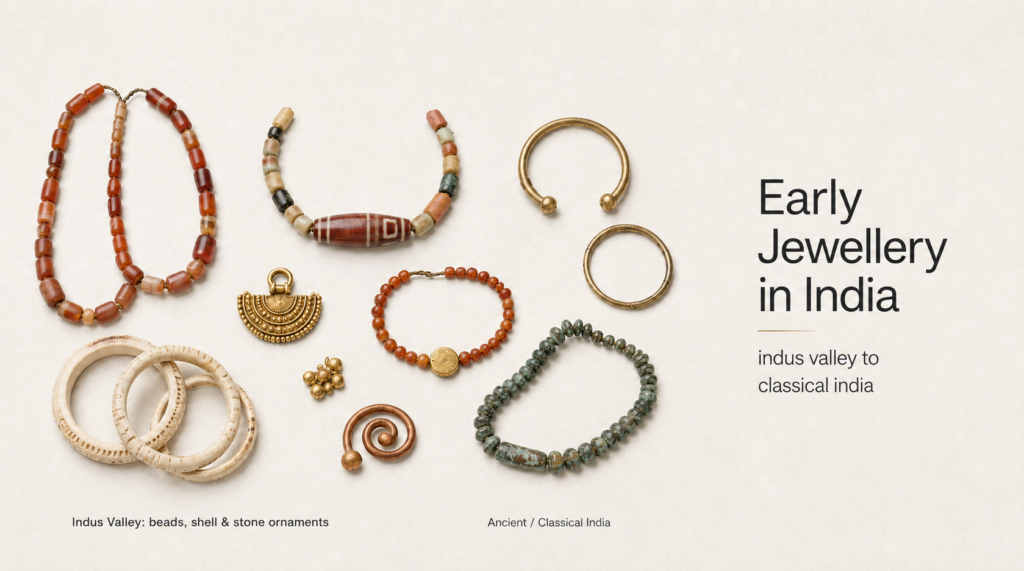
History of Jewellery in India
India deserves a particularly important place in the history of jewellery.
The Indian subcontinent developed one of the world’s richest and most continuous jewellery traditions, influenced over thousands of years by regional craftsmanship, royal patronage, religion, trade and access to gemstones.
Its importance extends beyond jewellery design.
India also played a central role in the early history of diamonds.
Jewellery in the Indus Valley Civilisation
The story begins with the Indus Valley Civilisation, which flourished more than 4,000 years ago.
Archaeological evidence shows considerable skill in ornament making. Craftspeople produced beads, bangles, necklaces and other ornaments using materials including:
- Gold
- Copper
- Carnelian
- Agate
- Shell
- Faience
- Steatite
Bead-making was particularly sophisticated.
Carnelian and other stones were shaped, drilled and polished, while extensive trading networks helped move materials and finished ornaments between settlements and distant regions.
Jewellery was already becoming a specialised craft rather than simply decoration.
Jewellery in Ancient and Classical India
As Indian kingdoms and empires developed, jewellery became deeply connected with society, religion, ceremony and royal life.
Sculptures, paintings and surviving ornaments show men and women wearing elaborate earrings, necklaces, armlets, waist belts, anklets, rings and hair ornaments.
Gold became particularly significant, while pearls and coloured gemstones added variety and symbolism.
Jewellery could communicate:
- Social standing
- Marital status
- Prosperity
- Religious belief
- Regional identity
- Royal authority
Many of these associations remain visible in Indian jewellery traditions today.
India and the Early History of Diamonds
India holds another extraordinary place in gem history.
For centuries, the Indian subcontinent was the world’s principal known source of diamonds. Diamonds were mined, traded and worked in India long before major deposits were discovered elsewhere.
Historical research describes India as central to the early mining, finishing and wearing of diamonds, with diamond-working knowledge later spreading towards Europe.
Indian diamonds would eventually travel through international trade routes and become part of royal collections across the world.
This relationship between India and diamonds would shape global jewellery history for centuries.
The Mughal Influence on Indian Jewellery
The Mughal period transformed Indian jewellery design through an extraordinary meeting of Indian craftsmanship, Persian aesthetics, gemstones and imperial patronage.
Mughal rulers had access to exceptional diamonds, emeralds, rubies, spinels and pearls.
Jewellery became increasingly elaborate, with gemstones appearing in:
- Necklaces
- Turban ornaments
- Earrings
- Armlets
- Rings
- Pendants
- Ceremonial objects
- Royal weapons
Gemstones were sometimes valued not only for their beauty but also for symbolism, inscriptions and perceived protective qualities.
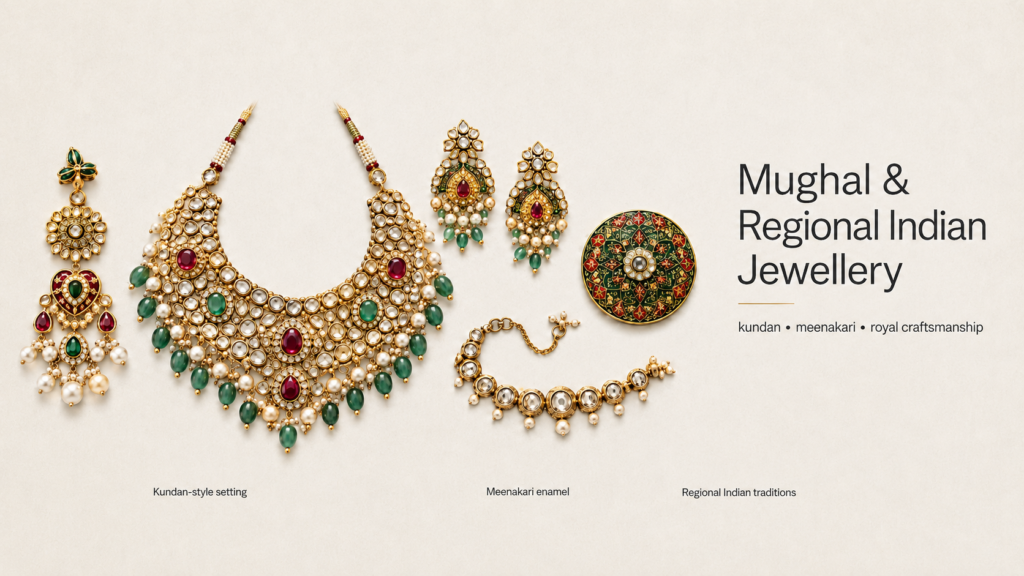
Kundan and Meenakari
Two techniques strongly associated with India’s royal jewellery traditions are Kundan and Meenakari.
Kundan jewellery involves setting stones using highly refined gold around the gemstone.
Meenakari involves decorating metal surfaces with coloured enamel.
The two techniques were often combined, producing jewellery that could be richly decorated on both the front and reverse.
These traditions eventually became deeply associated with jewellery centres such as Rajasthan and continue to influence Indian bridal and luxury jewellery today.
Regional Jewellery Traditions Across India
One reason Indian jewellery history cannot be represented by a single style is its extraordinary regional diversity.
Different parts of India developed distinctive techniques, materials and jewellery forms.
Rajasthan
Rajasthan became renowned for Kundan, Jadau, Meenakari and jewellery using diamonds and coloured gemstones.
Gujarat
Gujarati jewellery traditions include elaborate gold work, colourful gemstones, enamel and distinctive bridal ornaments.
South India
Gold plays a particularly prominent role in many South Indian jewellery traditions.
Temple-inspired jewellery developed into elaborate forms featuring deities, floral motifs and traditional iconography, while long necklaces, waist belts, earrings and other gold ornaments became closely associated with ceremonies and weddings.
Maharashtra
Traditional Maharashtrian jewellery includes distinctive pieces such as the nath, thushi and other regionally recognisable forms.
Across India, jewellery therefore became more than a universal symbol of beauty. It became a way of recognising region, community, ceremony and heritage.
Medieval Jewellery in Europe
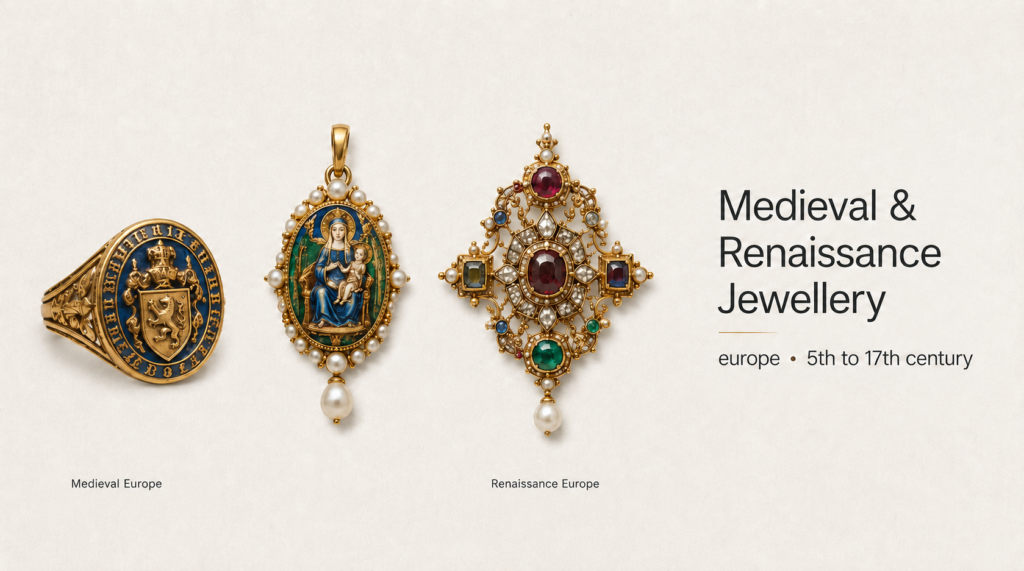
During the medieval period, jewellery in Europe was strongly influenced by religion and social hierarchy.
Gold, silver and gemstones were primarily accessible to royalty, nobility and wealthy members of society.
Brooches, rings, pendants and decorated belts were common among those who could afford them.
Gemstones were generally polished into smooth forms rather than cut into the highly faceted styles familiar today.
Many jewels also carried religious imagery, coats of arms or symbols of authority.
Jewellery had become a visible statement of who a person was and where they stood in society.
Renaissance Jewellery: Gemstones Take Centre Stage
The Renaissance brought renewed interest in art, science, global trade and craftsmanship.
Jewellery became more elaborate.
Gemstones such as:
- Diamonds
- Rubies
- Emeralds
- Sapphires
- Garnets
- Pearls
were increasingly incorporated into complex designs.
Enamel work became important, and pendants could be highly sculptural and richly decorated.
At the same time, advances in gemstone working gradually changed how diamonds were presented.
Instead of simply admiring a diamond’s natural crystal shape, cutters increasingly experimented with ways of improving its visual appearance.
That development would eventually transform diamond jewellery.
Georgian Jewellery: Diamonds and Hand Craftsmanship
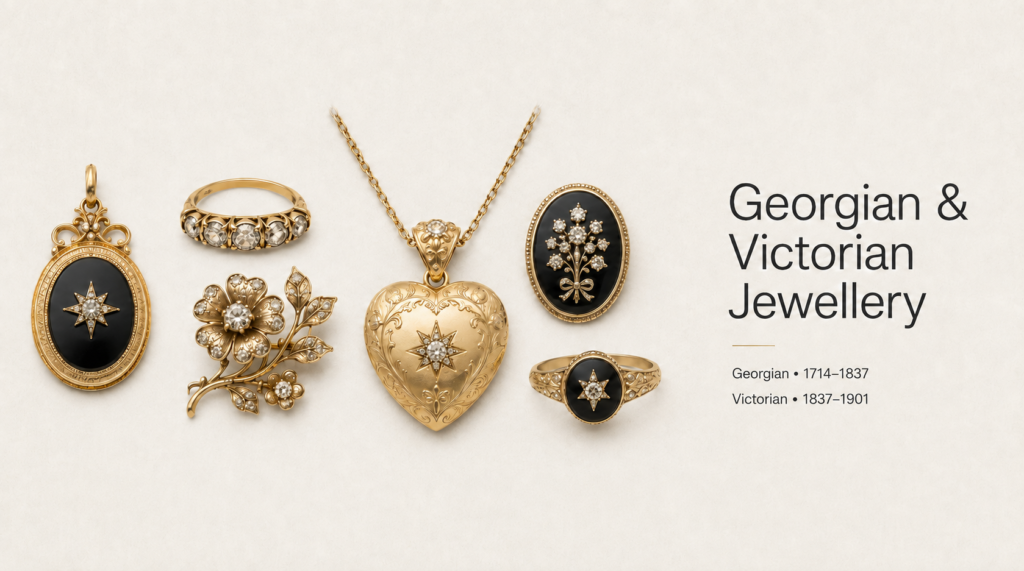
The Georgian period, broadly covering the 18th and early 19th centuries in Britain, produced jewellery that was largely handmade.
Gold and silver were common, while diamonds and coloured gemstones became increasingly important.
One major change occurred outside Europe.
The discovery of significant diamond deposits in Brazil during the 18th century changed the global diamond supply after centuries in which India had played the dominant role.
Improving cutting techniques also allowed jewellers to create pieces designed around the way diamonds reflected light.
Jewellery was slowly moving towards the brilliant, gemstone-centred designs familiar today.
Victorian Jewellery: Romance, Symbolism and Mourning
The Victorian era produced some of the most recognisable jewellery styles in Western history.
Jewellery changed significantly during Queen Victoria’s long reign.
Early Victorian Jewellery
Early designs often featured:
- Flowers
- Hearts
- Serpents
- Gold work
- Coloured gemstones
- Romantic symbolism
Mourning Jewellery
Following the death of Prince Albert in 1861, mourning influenced Victorian fashion.
Darker materials such as jet and onyx became popular, while sentimental jewellery could incorporate photographs, inscriptions or even woven hair.
Late Victorian Jewellery
As society and women’s fashions changed towards the end of the century, jewellery became more varied.
Diamonds benefited from improved cutting technology and expanding global supplies.
Jewellery was increasingly becoming accessible beyond royal and aristocratic circles.
Art Nouveau Jewellery: Nature Becomes the Inspiration
By the late 19th century, some designers began rejecting rigid historical styles.
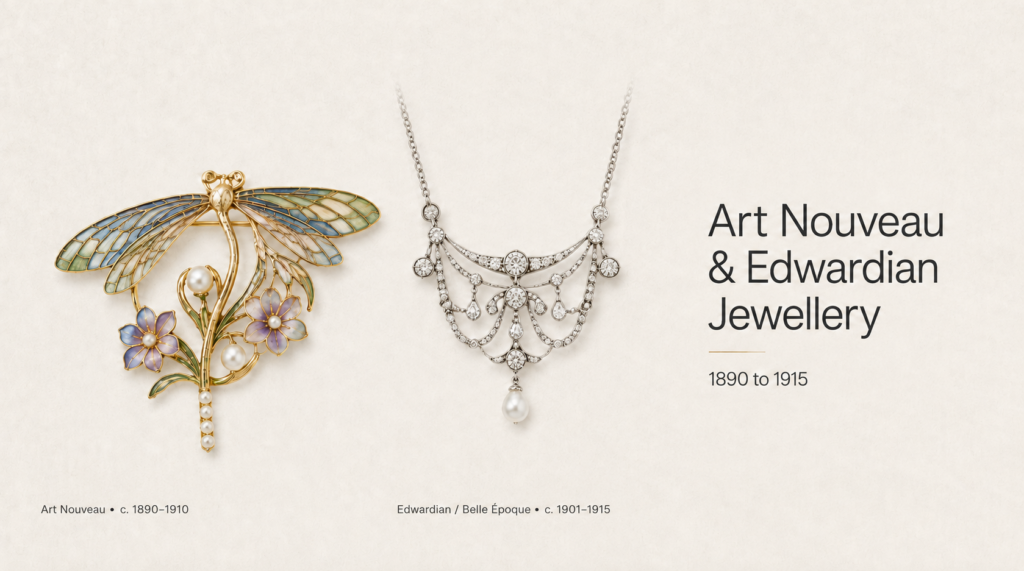
Art Nouveau, which flourished around the 1890s and early 1900s, celebrated flowing lines, nature and artistic expression.
Common inspirations included:
- Flowers
- Leaves
- Birds
- Butterflies
- Dragonflies
- The female form
Designers experimented with enamel, glass, opal, horn and gemstones.
Unlike periods in which the monetary value of the gemstone dominated the jewel, Art Nouveau often placed greater emphasis on the artistic composition of the entire piece.
Edwardian and Belle Époque Jewellery
At roughly the same time, another very different aesthetic was flourishing.
Edwardian and Belle Époque jewellery favoured elegance, delicacy and lightness.
Advances in metalworking helped platinum become an important jewellery metal. Because platinum is strong, jewellers could create finer settings with less visible metal.
Diamonds could therefore appear suspended in delicate lace-like designs.
Popular forms included:
- Diamond necklaces
- Tiaras
- Garlands
- Bows
- Ribbon motifs
- Fine bracelets
- Delicate earrings
White diamonds paired with platinum helped define the look.
Art Deco Jewellery: Geometry Changes Everything
After the flowing forms of Art Nouveau came one of jewellery history’s most influential design movements.
Art Deco flourished particularly during the 1920s and 1930s.
The style favoured:
- Straight lines
- Symmetry
- Geometric shapes
- Strong colour contrast
- Modern architecture-inspired forms
Diamonds were frequently paired with emeralds, rubies, sapphires, onyx and other contrasting materials.
New and increasingly precise gemstone cuts complemented the geometric aesthetic.
Baguette, emerald, Asscher and other angular shapes became particularly effective in Art Deco designs.
The 1925 Paris Exposition Internationale des Arts Décoratifs et Industriels Modernes helped give the movement its name, and its geometric style continues to influence jewellery a century later.
Retro Jewellery and the 1940s
World War II again changed jewellery.
Platinum became difficult to obtain for civilian jewellery production in some markets because of its strategic industrial importance.
Yellow and rose gold gained prominence.
Retro jewellery was often larger and bolder than the delicate jewellery of the preceding decades.
Common design characteristics included:
- Oversized rings
- Bold bracelets
- Large brooches
- Curves and scrolls
- Rose and yellow gold
- Three-dimensional designs
Even when gemstones were limited, designers used metal creatively to produce visually dramatic pieces.
Jewellery in the 1950s and 1960s
After the war, jewellery again became more glamorous.
Diamonds, pearls and coloured gemstones returned to sophisticated necklaces, earrings and brooches.
At the same time, rising incomes and industrial manufacturing meant jewellery was no longer restricted to a small wealthy elite.
By the 1960s and 1970s, designers were experimenting more freely with form.
Jewellery could now be:
- Fine jewellery
- Fashion jewellery
- Artistic jewellery
- Traditional jewellery
- Everyday jewellery
The boundaries were expanding.
How Diamond Cutting Changed Jewellery History
One of the biggest changes in jewellery history did not come from a new gemstone.
It came from learning how to cut an existing one.
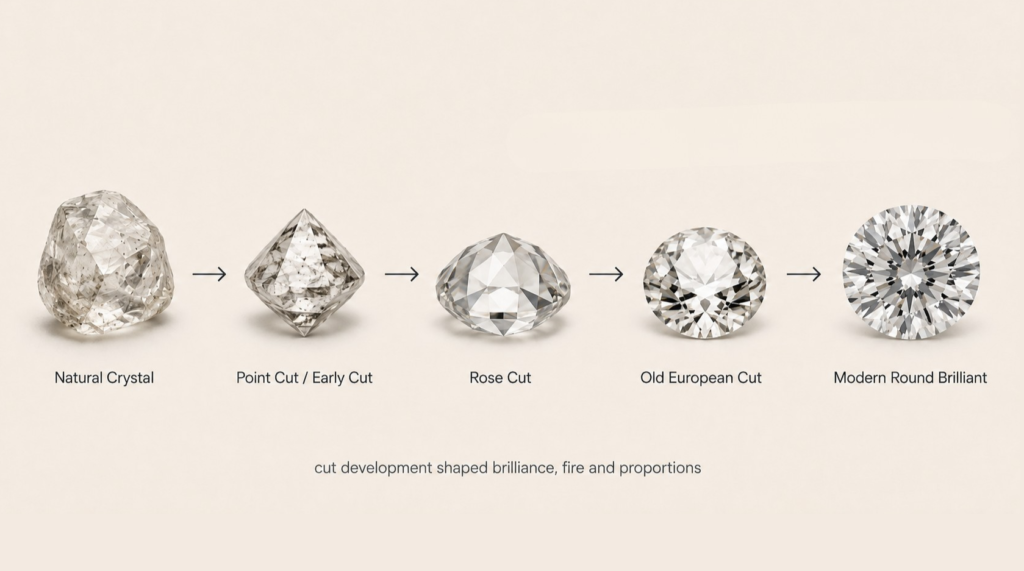
Early diamonds were valued largely for their natural crystal form and rarity.
Over centuries, cutters developed ways of shaping and faceting diamonds to manipulate how light travels through them.
This led to increasingly sophisticated cutting styles and eventually the modern round brilliant and numerous fancy shapes used today.
Diamond jewellery therefore evolved from showcasing the natural form of the stone to deliberately enhancing its brilliance, fire and visual proportions.
Today, the appearance of a polished diamond is closely connected with the quality of its cut.
The Rise of Laboratory-Grown Diamonds
Another major chapter in jewellery history began in the 20th century.
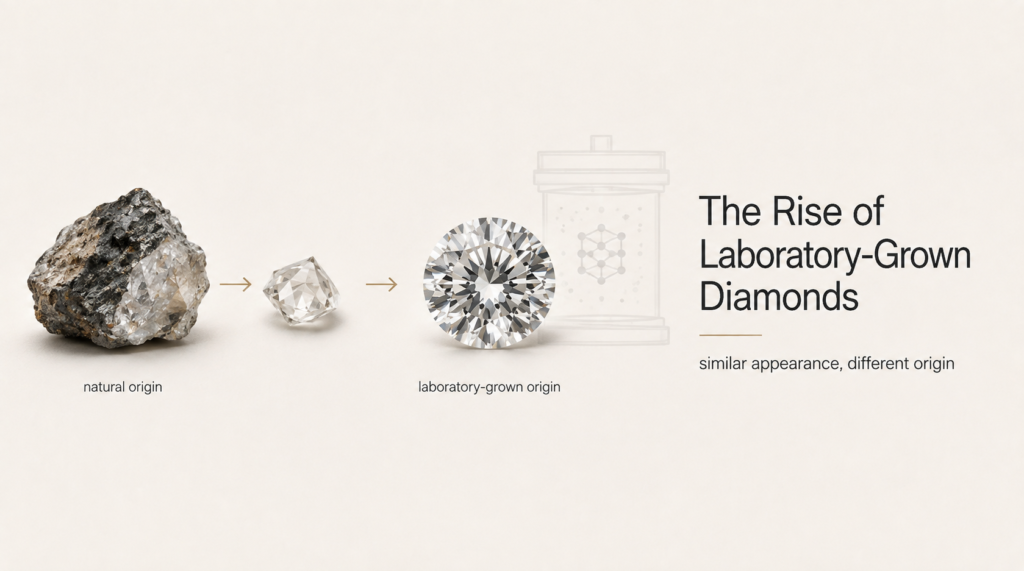
Scientists succeeded in creating diamonds under controlled laboratory conditions.
Early laboratory-grown diamonds were largely intended for industrial applications. Gem-quality material improved considerably over subsequent decades.
By the mid-2010s, colourless laboratory-grown diamonds had become commercially available in jewellery in significant quantities. Modern laboratory-grown diamonds are primarily produced through HPHT, High Pressure High Temperature, or CVD, Chemical Vapor Deposition, processes.
This created something earlier jewellery buyers rarely had to consider:
Two diamonds can appear extremely similar while having fundamentally different origins.
One formed naturally deep within the Earth.
Another was grown using technological processes.
That distinction helped make advanced gemological testing increasingly important.
Modern Jewellery: Design Meets Science
Today’s jewellery industry would be almost unrecognisable to an ancient goldsmith.
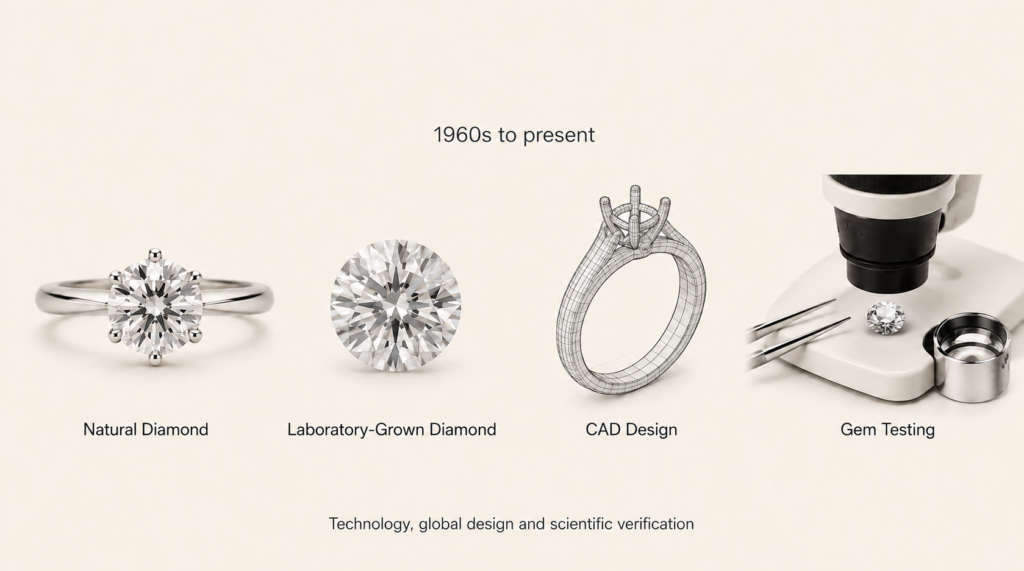
Jewellery designers now work with technologies including:
- Computer-aided design
- Precision casting
- Laser cutting
- Laser inscription
- Advanced gemstone cutting
- 3D modelling
- Modern manufacturing techniques
Consumers also have access to a wider range of materials than at any other point in history.
A contemporary jewellery piece may contain:
- Natural diamonds
- Laboratory-grown diamonds
- Natural gemstones
- Synthetic gemstones
- Treated gemstones
- Imitation materials
Many of these distinctions cannot reliably be determined simply by looking at a stone.
For example, colourless laboratory-grown diamonds share essentially the same chemical and optical properties as natural diamonds, and conclusive identification may require specialised testing.
This is where the history of jewellery enters its newest chapter.
From Jewellery History to Jewellery Certification
Jewellery has evolved dramatically over thousands of years, and so have the materials used to create it. Today, a jewellery piece may contain natural diamonds, laboratory-grown diamonds, natural gemstones, synthetic stones or treated gemstones, and these differences may not always be visible to the eye.
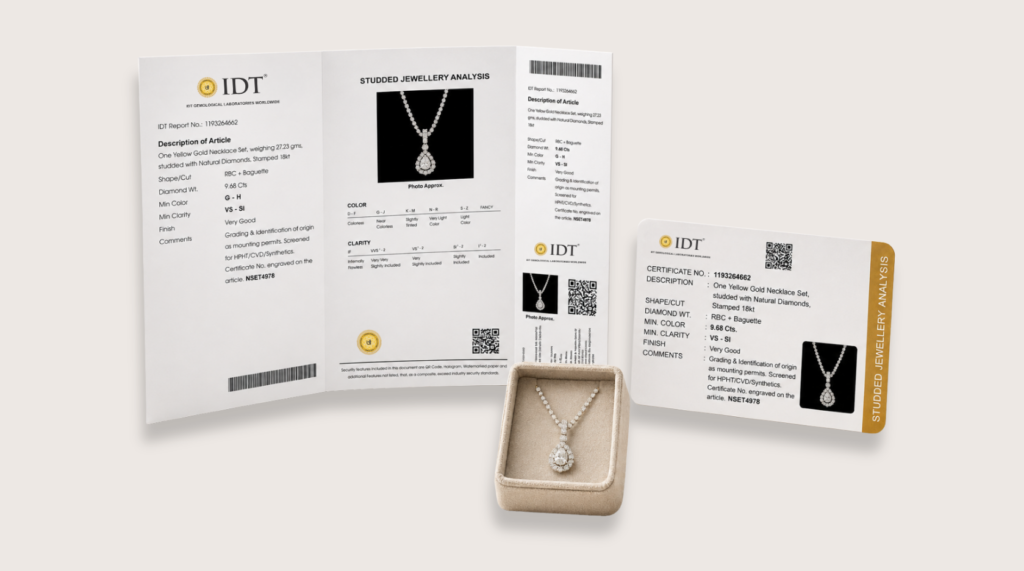
This is where IDT Certification becomes important. At IDT Gemological Laboratories Worldwide, diamonds, gemstones and studded jewellery are professionally examined using gemological testing and advanced analytical methods. Depending on the type of jewellery or stone, an IDT report can provide important information about its identity and characteristics, helping buyers understand what their jewellery actually contains.
From ancient ornaments chosen largely for beauty and symbolism to modern jewellery backed by scientific testing, the jewellery journey has entered a new era: one where beauty can come with clarity too.
Always insist on IDT Certification.
Frequently Asked Questions About the History of Jewellery
What is the history of jewellery?
The history of jewellery dates back at least 142,000 years to perforated shell ornaments used by early humans. Jewellery later evolved through ancient civilisations such as Egypt, Mesopotamia and the Indus Valley, followed by major periods including the Renaissance, Georgian, Victorian, Art Nouveau and Art Deco eras. Modern jewellery combines traditional craftsmanship with advanced manufacturing and gemological testing.
What is the oldest jewellery ever discovered?
Among the oldest known personal ornaments are perforated shell beads discovered at Bizmoune Cave in Morocco. Archaeological research dates deposits containing many of these beads to at least 142,000 years ago.
Where did jewellery originate?
Jewellery does not appear to have originated from a single modern country or civilisation. Personal ornaments were used by prehistoric humans long before organised ancient civilisations developed. Some of the oldest known shell ornaments have been found in North Africa.
When did people start making gold jewellery?
Gold ornaments were being made thousands of years ago. Surviving Egyptian gold objects used for personal adornment date to the fourth millennium BCE, while other early civilisations also developed sophisticated goldworking traditions.
What is the history of jewellery in India?
Indian jewellery history extends back to the Indus Valley Civilisation, where craftspeople produced sophisticated beads, bangles and metal ornaments. Jewellery evolved through ancient kingdoms and regional traditions and later received major royal patronage during the Mughal period. India also played a central role in the early global history of diamonds.
Why is India important in diamond history?
India was the major early source of diamonds and played an important role in diamond mining, working and trade before significant deposits were discovered in other parts of the world. Historical research places India at the centre of the early global diamond industry.
How did jewellery change during the Art Deco period?
Art Deco jewellery moved towards geometric shapes, symmetry and bold colour contrasts. Diamonds were often combined with emeralds, rubies, sapphires, onyx and platinum. Angular gemstone cuts became particularly suited to these designs.
When did laboratory-grown diamonds become part of jewellery history?
Laboratory-grown diamonds were successfully produced during the 20th century, initially largely for industrial use. Gem-quality production improved over time, and by the mid-2010s colourless laboratory-grown diamonds were commercially available in the jewellery market in significant quantities.
Why is jewellery certification important today?
Modern jewellery can contain natural diamonds, laboratory-grown diamonds, natural gemstones, synthetic gemstones and treated materials that may look similar to the unaided eye. Gemological testing can provide documented information about their identity and characteristics, helping consumers understand what their jewellery contains.