
You have the bill.
You have the jewellery box.
But do you actually have proof of what’s inside your jewellery?
Many people buy diamond or gemstone jewellery and assume the paperwork they receive tells the complete story. In reality, a purchase bill is not the same as a jewellery certificate. Likewise, a certificate for a solitaire diamond does not necessarily verify every diamond or gemstone in a finished jewellery piece.
Whether you’re buying new jewellery, planning to sell it in the future, or simply want peace of mind, understanding jewellery certification can help you make informed decisions.
This guide explains what jewellery certification is, what it verifies, how it differs from a bill or appraisal, and how you can verify your jewellery in just a few minutes.
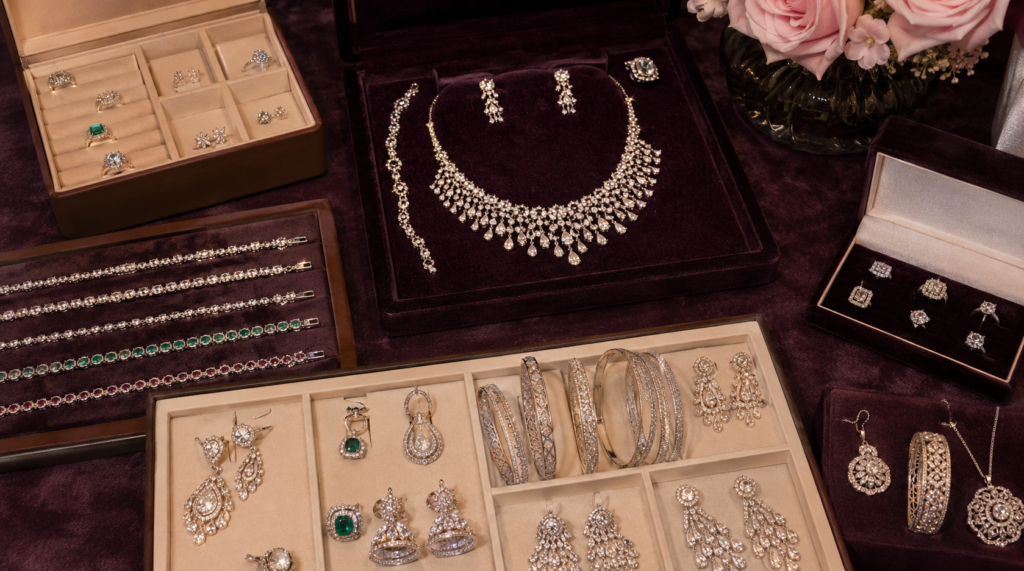
Table of Contents
- What Is Jewellery Certification?
- Certificate vs Bill vs Appraisal
- What Does Jewellery Certification Actually Check?
- Why Solitaire Certificates Aren’t Always Enough
- Three Red Flags Your Jewellery Isn’t Properly Certified
- How to Verify Your Existing Jewellery
- Frequently Asked Questions
What Is Jewellery Certification?
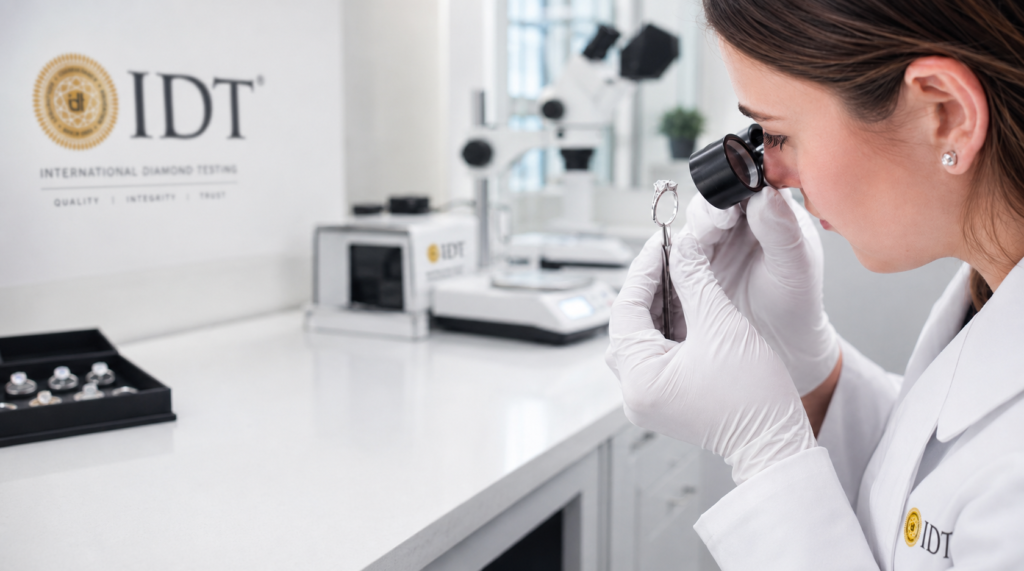
Jewellery certification is an independent examination of a jewellery piece by a gemological laboratory.
The laboratory evaluates the diamonds and gemstones in the jewellery and documents their identity, characteristics, and other relevant observations in a report. This helps create an independent record of the jewellery at the time it was examined.
For consumers, certification provides transparency.
For jewellers, it helps demonstrate exactly what is being sold.
Certificate vs Bill vs Appraisal – What’s the Difference?
Many buyers confuse these three documents, but they serve very different purposes.
| Document | Purpose | Issued By |
| Purchase Bill | Proof of purchase and transaction | Jeweller |
| BIS Hallmark | Confirms the purity of gold or precious metal | BIS-authorised hallmarking centre |
| Jewellery Certificate | Documents the identity and characteristics of the diamonds and gemstones in the jewellery | Independent gemological laboratory |
| Jewellery Appraisal | Provides an estimated value for insurance or other purposes | Appraiser |
A purchase bill tells you what was sold.
A hallmark relates to the precious metal.
A jewellery certificate focuses on the diamonds and gemstones.
An appraisal estimates value.
Each document serves a different purpose.
What Does Jewellery Certification Actually Check?
A jewellery certification report typically evaluates several important aspects of a jewellery piece.
1. Stone Identification
The laboratory identifies whether the stones are:
- Natural diamonds
- Laboratory-grown diamonds
- Natural coloured gemstones
- Other gem materials or simulants
2. Treatment Detection
Many gemstones undergo treatments to improve their appearance.
Where detectable, laboratories may report treatments such as:
- Heat treatment in rubies or sapphires
- Fracture filling in emeralds
- Other commonly recognised gemstone enhancements
Treatment disclosure helps buyers better understand the jewellery they own.
3. Weight
Depending on the jewellery piece, the report may include:
- Centre stone weight
- Total weight of side stones
- Total gemstone weight where applicable
4. Quality Characteristics
For diamonds, reports may describe characteristics such as:
- Colour
- Clarity
- Cut (where applicable)
For coloured gemstones, laboratories may describe characteristics including colour and other identifying observations.
5. Stone-to-Report Matching
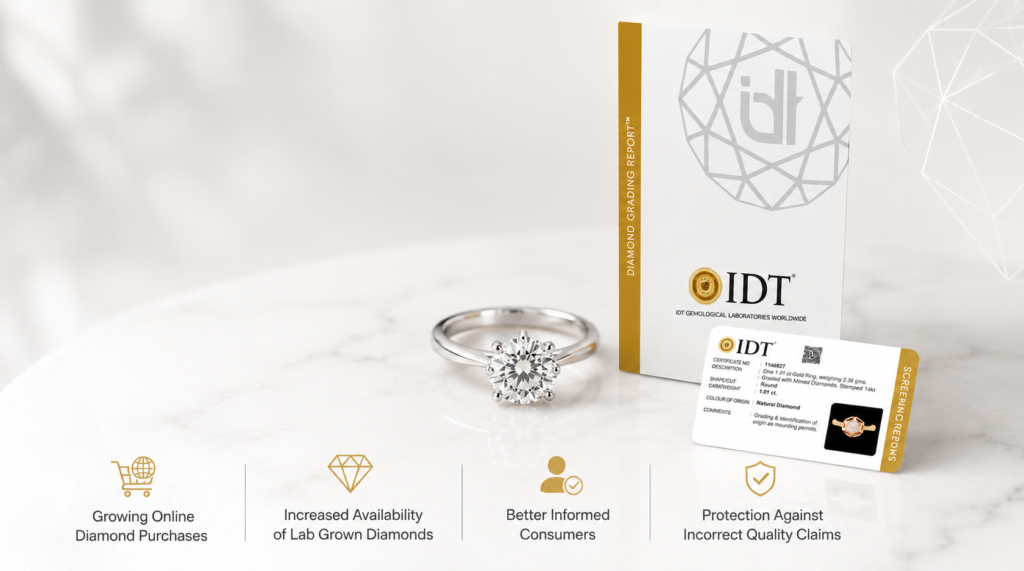
A jewellery report may also include features that help connect the physical jewellery to the report, such as:
- Photograph of the jewellery
- Report number
- QR verification
- Laser inscription details (where applicable)
These features help identify the jewellery examined by the laboratory.
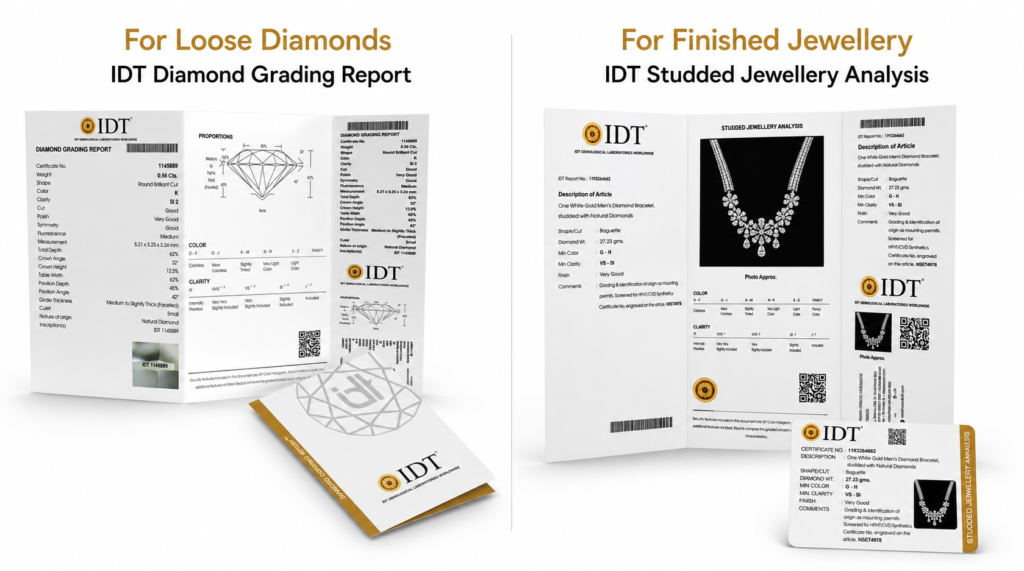
Why Solitaire Certificates Aren’t Always Enough
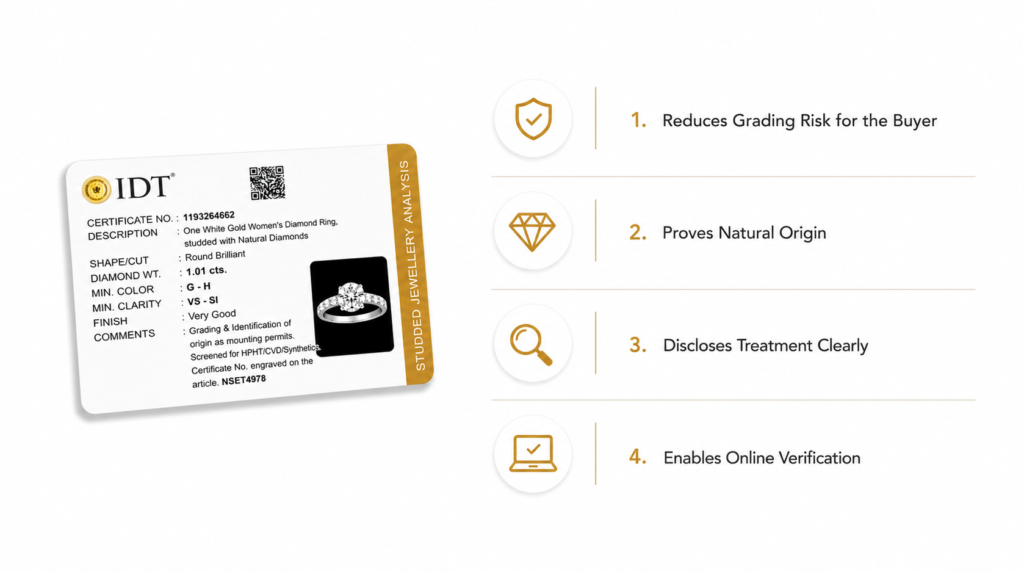
One of the most common misunderstandings among jewellery buyers is assuming that a solitaire certificate covers the entire jewellery piece.
Imagine buying a ring with:
- One 1.00 ct centre diamond
- Twenty side diamonds weighing 0.50 ct in total
The certificate may describe only the centre diamond.
The side stones may not appear anywhere on that report.
This doesn’t automatically mean anything is wrong. Many jewellers clearly explain what is and isn’t covered by a certificate.
However, if you want documentation for the complete jewellery piece, it’s worth asking whether a jewellery certificate covering the entire item is available.
For studded jewellery, a jewellery certificate generally provides a more complete record than a report covering only the centre stone.
Three Red Flags Your Jewellery May Not Be Properly Certified
1. The Bill Says “Certified” But There’s No Report
A bill mentioning “certified” without an accompanying laboratory report, report number, or QR code is not the same as independent certification.
2. The Report Cannot Be Verified
If the report number cannot be verified on the issuing laboratory’s official website, or the report displays details that don’t match your jewellery, you should seek clarification before relying on it.
3. Only One Stone Is Documented
If your jewellery contains multiple diamonds or gemstones but the report describes only a single centre stone, ask whether certification for the complete jewellery piece is available.
How to Verify Your Existing Jewellery
Verifying jewellery usually takes only a few minutes.
Step 1
Locate the report number on your certificate.
Step 2
Use the QR code or visit the issuing laboratory’s official verification page.
Step 3
Compare the report with your jewellery.
Check details such as:
- Photograph
- Stone weight
- Measurements
- Other identifying information
Step 4
Where applicable, ask your jeweller to show the laser inscription under magnification and confirm that it matches the report.
Not every certified diamond carries a laser inscription. Whether an inscription is present depends on factors such as the diamond’s size and the laboratory’s certification policy.
Why IDT Certification Matters
IDT Certification adds an independent layer of trust and transparency to every jewellery purchase.
It helps buyers clearly understand what they own and provides jewellers with a credible, independent record of the jewellery they sell. It also makes future verification, resale, insurance, or family transfers easier.

Whether you are buying jewellery for yourself, as an investment, or as a family heirloom, IDT Certification gives you greater clarity, confidence, and peace of mind.
Always insist on IDT Certification.
Frequently Asked Questions
Is jewellery certification mandatory in India?
No.
BIS hallmarking applies to gold purity under applicable regulations, while certification of diamonds and gemstones is generally voluntary.
Can old jewellery be certified?
Yes.
Existing jewellery can usually be submitted to a gemological laboratory for examination. Depending on the jewellery design, stones may be tested while mounted or may require additional procedures.
What is the difference between hallmark and jewellery certification?
A hallmark relates to the purity of the precious metal.
Jewellery certification documents the identity and characteristics of the diamonds and gemstones in the jewellery.
Does a jewellery certificate include gold purity?
Jewellery certificates primarily focus on the diamonds and gemstones.
Gold purity is generally addressed through BIS hallmarking.
Is a jewellery certificate the same as an appraisal?
No.
A jewellery certificate documents gemological observations.
An appraisal estimates monetary value for purposes such as insurance or valuation.