
Natural vs Synthetic vs Glass Filled Ruby: How to Tell the Difference
“Is My Ruby Real?” The Question IDT Gets Daily You’re buying a ruby for Sun in astrology. Or maybe for a ring. The seller says it is a “natural ruby” and the price looks good. But is it really natural? There are three common types of ruby you may come across in the market: The problem is that all three can look very similar to the eye. Based on stones submitted to IDT for testing in 2025 to 2026, approximately 41% of rubies represented as “natural” were actually synthetic or glass filled. Most buyers only found out after IDT testing. This guide explains the differences between these ruby types, how IDT identifies them, and why the Conclusion and Comments sections of your ruby certification matter before you buy. Type 1: Natural Ruby What is a Natural Ruby? Natural ruby is a variety of corundum that forms naturally in the earth over millions of years. Its red colour comes mainly from chromium. Rubies are mined in regions including Burma, Mozambique, Thailand, and Madagascar. Key Features Inclusions: Natural rubies often contain internal characteristics such as silk, crystals, and fingerprints. Exceptionally clean natural rubies are rare. Durability: Ruby has a hardness of 9 on the Mohs scale, making it suitable for jewellery. Astrology: In Vedic astrology, ruby is commonly associated with the Sun. Many astrologers prefer natural and unheated ruby. What the IDT Certificate May State Results: Natural Corundum, RedConclusion: NaturalComments: No indications of heating or Indications of heating Type 2: Synthetic Ruby or Lab Grown Ruby What is Synthetic Ruby? Synthetic ruby is corundum grown in a laboratory. It has the same basic chemical composition and hardness as natural ruby, but its origin is different. Natural ruby forms in the earth, while synthetic ruby is created under controlled laboratory conditions. How is Synthetic Ruby Made? Common production methods include: These processes can produce rubies that appear very clean to the naked eye. Key Features Inclusions: Synthetic rubies may appear eye clean or show characteristics such as curved growth lines under magnification. Durability: Synthetic ruby also has a hardness of 9 on the Mohs scale. Astrology: Views on synthetic ruby vary among astrologers. Many prefer natural ruby, while others may consider synthetic stones depending on individual beliefs and budget. What the IDT Certificate May State Results: Laboratory Grown Corundum, Red or Lab Grown Corundum, RedConclusion: Synthetic / Laboratory GrownComments: The growth method may also be mentioned when detected. Synthetic ruby is real corundum, but it is not naturally formed. The important thing is knowing exactly what you are buying and paying the appropriate price for it. Learn more in our Lab Grown Gemstone Guide. Type 3: Glass Filled Ruby or Lead Glass Ruby What is Glass Filled Ruby? Some natural rubies contain a large number of fractures. In glass filled ruby, these fractures are filled with glass to improve transparency and overall appearance. Why is Glass Filling Done? A heavily fractured ruby may look opaque or unattractive. Filling the fractures with glass can make the stone appear cleaner and more transparent. However, this treatment significantly affects its value, durability, and care requirements. Key Features Appearance: Glass filled ruby can appear surprisingly clean and bright for its price. Durability: The ruby itself is hard, but the glass filling is much softer and can be damaged by heat, acids, or certain jewellery cleaning methods. Value: Glass filled ruby is generally worth considerably less than a comparable untreated natural ruby. Disclosure: The treatment should always be disclosed to the buyer. What the IDT Certificate May State Results: Natural Corundum, RedConclusion: NaturalComments: Indications of clarity enhancement with glass or Lead glass filling detected Important: Glass filled rubies require special care. Heat used during jewellery repairs can damage the filling, so always check the Comments section of the gemstone report before repair Natural vs Synthetic vs Glass Filled Ruby: Key Differences Feature Natural Ruby Synthetic Ruby Glass Filled Ruby Origin Formed naturally in earth Grown in a laboratory Natural ruby treated with glass Material Natural corundum Laboratory grown corundum Natural corundum with glass filling Appearance Often shows natural inclusions Can appear very clean May appear unusually clean and transparent Hardness 9 on Mohs scale 9 on Mohs scale Ruby is 9, but glass filling is softer Value Generally higher Usually lower than comparable natural ruby Usually much lower than untreated natural ruby IDT Conclusion Natural Synthetic / Laboratory Grown Natural IDT Comments Heating status Growth information may be mentioned Glass filling or clarity enhancement disclosed How IDT Detects Each Type When you submit a ruby to IDT labs in Delhi, Mumbai, Surat, Kolkata, Thrissur, Chennai, or our three Dubai locations, gemologists examine the stone using specialised testing methods. 1. High Powered Microscopy Gemologists study internal characteristics and inclusions. Natural silk, synthetic growth features, and characteristics associated with glass filling can help identify the nature of the stone. 2. Spectroscopy Spectroscopic testing helps gemologists study how the stone interacts with light and can provide important information about its composition and origin. 3. UV Fluorescence Different rubies may react differently under ultraviolet light. These reactions provide additional information during testing. 4. Refractometer Refractive index testing helps identify gemstone materials and can also assist in recognising glass present at or near the surface. 5. Advanced Gemological Instruments Additional instruments and testing techniques may be used to confirm the gemstone species and detect treatments or laboratory growth. Understanding Your IDT Certificate Three sections are especially important: Results: Identifies the gemstone species. Conclusion: States whether the stone is natural or synthetic / laboratory grown. Comments: Provides information about treatments such as heating or glass filling. Quote from Gaurav Issar, Founder, IDT “Ruby buyers ask us daily: is it natural or synthetic? Is it glass filled? You cannot tell by eye. Synthetic can be flawless. Glass filled can look better than natural. IDT tests every ruby. Conclusion tells you if it’s Natural or Synthetic. Comments tells you if it’s heated or glass filled. Check both before you pay. Verify free at idtworldwide.com/verify.” 3
Gemstone for Which Planet? Complete Astrology Gemstone Chart (2026)
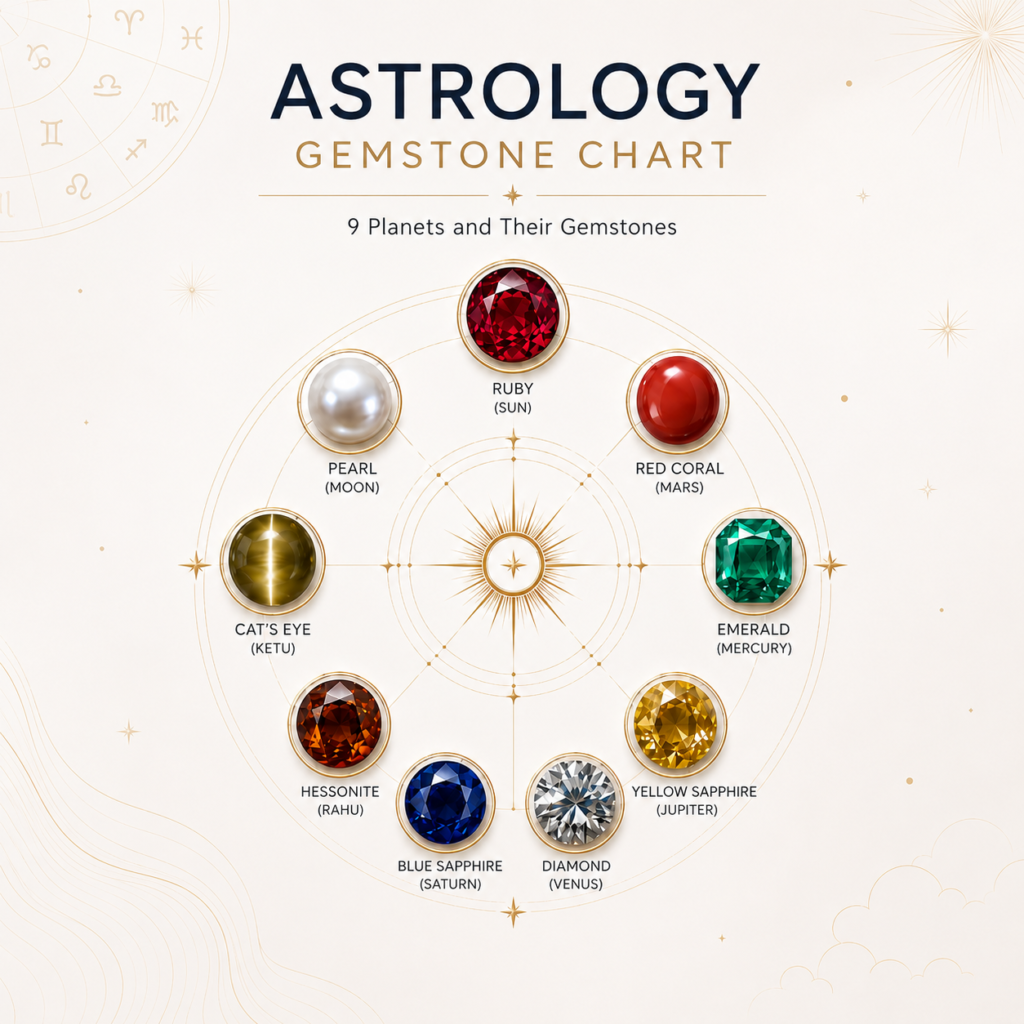
If an astrologer recommends a gemstone for a particular planet, you may come across several stones associated with the same planet. For example, yellow sapphire is traditionally associated with Jupiter, while citrine and yellow topaz may also be suggested as substitutes by some astrologers. But these are different gemstones with different identities and values. That is why, apart from knowing which gemstone has been prescribed, it is equally important to know what gemstone you are actually buying. In Vedic astrology, nine primary gemstones are traditionally associated with the Navagrahas. These are commonly referred to as Navratna gemstones or Navagraha gemstones. This guide explains the primary planetary gemstones, commonly suggested substitutes and how gemstone certification can help you verify what you are buying. Important: IDT does not advise which gemstone a person should wear for astrological purposes. The associations mentioned below reflect traditional Vedic astrology practices. Always consult your astrologer for a personal recommendation. Complete Astrology Gemstone Chart: 9 Planets and Their Gemstones Planet Primary Gemstone Common Name Sun Ruby Manik Moon Pearl Moti Mars Red Coral Moonga Mercury Emerald Panna Jupiter Yellow Sapphire Pukhraj Venus Diamond Heera Saturn Blue Sapphire Neelam Rahu Hessonite Garnet Gomed Ketu Chrysoberyl Cat’s Eye Lehsunia These nine gemstones make up the traditional Navratna gemstone system. However, an astrologer may sometimes recommend a substitute stone depending on the individual’s horoscope, requirements or budget. Primary vs Substitute Astrology Gemstones A primary gemstone is the stone traditionally associated with a particular planet in the Navratna system. A substitute gemstone is an alternative that some astrologers may recommend instead of the primary gemstone. Examples include: Substitute recommendations can vary between astrologers, so always follow the prescription given specifically to you. Where the Problem Begins The issue is not necessarily buying a substitute gemstone. The issue is buying one gemstone while being told it is another. For example, if you knowingly purchase citrine as a substitute for yellow sapphire and pay accordingly, the transaction is transparent. But if you are sold citrine as yellow sapphire, you are not receiving the gemstone represented to you at the time of purchase. That is where independent gemstone certification becomes important. Why Knowing the Exact Gemstone Matters Many coloured gemstones can appear similar to an untrained eye. A yellow sapphire and citrine, for example, may both appear yellow, but they belong to completely different mineral species. Similarly, natural and synthetic gemstones may look very similar without proper gemological testing. Visual appearance alone therefore cannot always confirm: A gemological laboratory examines the gemstone using professional testing methods and records the findings on a report. How IDT Gemstone Certification Helps IDT Gemological Laboratories independently tests gemstones and reports their gemological characteristics. IDT does not decide whether a gemstone is astrologically suitable for you. Instead, certification helps answer a different question: What gemstone do you actually have? For example, testing can help distinguish between: Once you know what the gemstone is, you can compare the report with: Learn more about Gemstone Certification. Natural, Synthetic, Heated and Unheated Gemstones When purchasing an astrology gemstone, you may frequently hear terms such as natural, synthetic, heated and unheated. These terms should not be used interchangeably. Natural Gemstone A natural gemstone has formed through geological processes rather than being manufactured in a laboratory. Synthetic or Lab-Grown Gemstone A synthetic or laboratory-grown gemstone is produced in a controlled environment rather than formed naturally. Heated Gemstone Some gemstones may undergo heat treatment to modify or improve their appearance. Unheated Gemstone An unheated gemstone shows no indications of heat treatment during gemological examination. Different astrologers may have different preferences regarding natural, synthetic, treated or untreated gemstones. IDT’s role is not to determine which one you should wear. It is to test the gemstone and report the findings. How to Read the Relevant Information on an IDT Gemstone Report When checking an IDT gemstone certificate, focus on what the report actually confirms. 1. Gemstone Identification Check the gemstone identification stated on the report. This tells you what gemstone was identified during testing. For example: Natural Corundum – Yellow and Natural Quartz – Citrine represent different gemstone materials, even though both may appear yellow. 2. Conclusion The Conclusion states whether the tested gemstone is identified as Natural or Synthetic/Lab Grown, where applicable. If you were specifically told that you were purchasing a natural gemstone, this is an important section to check. 3. Comments The Comments section records treatment-related observations where applicable. For gemstones where heat treatment can be evaluated, the report may state: If your astrologer has specifically recommended an unheated gemstone, check this section carefully. A Simple Example: Yellow Sapphire vs Citrine Suppose your astrologer recommends a yellow sapphire for Jupiter. At the jewellery store, you are offered a yellow stone. By appearance alone, you may not be able to confirm whether it is yellow sapphire or another yellow gemstone. Gemological testing may identify it as: Natural Corundum – Yellow or Natural Quartz – Citrine Both are gemstones, but they are not the same gemstone. Certification therefore helps you know what you are purchasing before comparing it with your astrologer’s recommendation. See Yellow Sapphire Certification for more information. Natural Ruby vs Synthetic Ruby The same concern can arise when purchasing a ruby for the Sun. A buyer may specifically request a natural ruby, while the stone being offered could be synthetic. Professional testing helps establish the identity of the gemstone and whether it is natural or synthetic. If your requirement is specifically a natural gemstone, check the Conclusion on the IDT report before making your decision. Read more about Ruby Certification. Astrology Gemstone Buying Checklist Before buying a gemstone recommended for astrological purposes: 1. Know Exactly What Your Astrologer Recommended Ask whether the recommendation specifies: 2. Ask the Seller What Gemstone Is Being Sold Do not rely only on colour or appearance. Ask for the exact gemstone name. 3. Get the Gemstone Professionally Tested Ask for an independent gemstone certification report so that you can verify the identity of the stone. 4. Check Whether
Gemstone Certification Guide: How to Read an IDT Gemstone Certificate
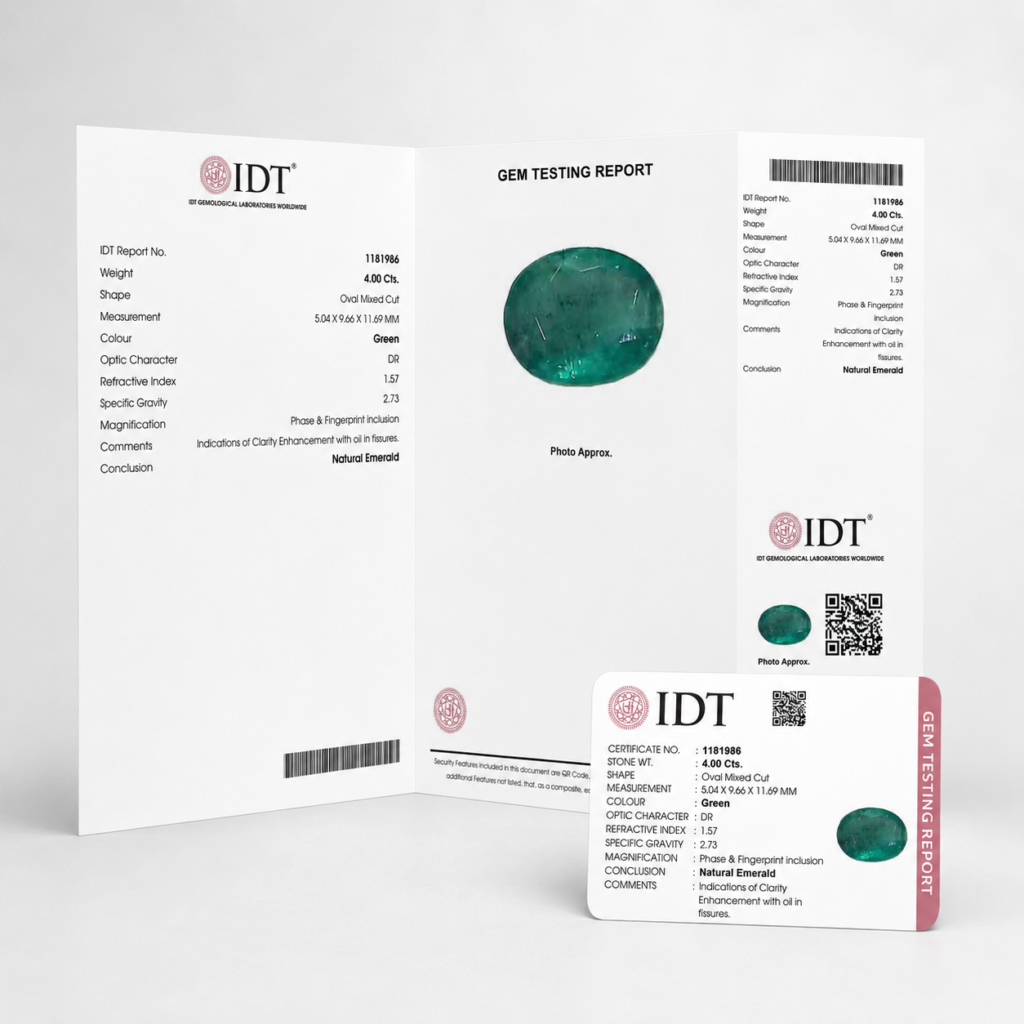
You Have the Gemstone Certificate. But Do You Know What It Says? You asked for gemstone certification. The seller handed you a gemstone certificate or gemological report. It contains terms such as Conclusion, Comments, Refractive Index, Specific Gravity, Optic Character and Magnification. But what do these fields actually mean? Which ones tell you whether a gemstone is natural or synthetic? And where should you look for information about treatments? Understanding a gemstone certificate can help you know what has actually been identified instead of relying only on colour, appearance or seller claims. This guide uses a real IDT GEM TESTING REPORT for a 4.00 Ct Emerald to explain the important fields on a gemstone certificate and how to read them. What Is Gemstone Certification? Gemstone certification is the process of having a gemstone examined by a gemological laboratory using professional testing methods and instruments. After examination, the laboratory issues a gemstone identification report containing information recorded during testing. Depending on the gemstone and report type, a gemstone certificate may provide information such as: Gemstone certification can help buyers understand whether the stone matches the description provided by the seller. For example, two green gemstones may appear similar to the eye, but professional gemological testing may identify them as completely different materials. This is why a gemstone certificate should be read carefully rather than relying only on the gemstone’s colour or appearance. What Is a Certified Gemstone? A certified gemstone is commonly used to describe a gemstone that has been examined by a gemological laboratory and is accompanied by a gemstone identification report. The report records the findings of the laboratory at the time of testing. However, having a certificate does not mean every gemstone is untreated, natural or of a particular quality. You still need to read the information written on the report. For example: The certificate tells you what the laboratory observed. This is why knowing how to read a gemstone certificate is just as important as asking for one. The 2 Most Important Fields on Every IDT Gemstone Certificate On the standard IDT Gem Testing Report, two of the most important fields for a buyer are: The Conclusion identifies the gemstone, while Comments may provide important information about detectable treatments or other observations. In this sample IDT gemstone certificate, the Conclusion reads: Natural Emerald Let’s understand what that means. 1. Conclusion What it says on this report:Natural Emerald What it means:The gemstone was identified as Emerald and determined to be natural rather than synthetic or laboratory grown. Emerald is the green variety of Beryl. Why it matters:This field tells you what the gemstone actually is. For example, if you purchased an Emerald but the Conclusion stated Natural Quartz – Green, the gemstone would not be Emerald. Similarly, if the Conclusion stated Synthetic Beryl – Green, the material would be laboratory grown rather than a natural Emerald. Always compare the Conclusion on the gemstone certificate with what the seller told you or what appears on your invoice. 2. Comments What it says on this report:Indications of Clarity Enhancement with oil in fissures. What it means:The Emerald shows indications of oil being present in surface-reaching fissures. Oiling is commonly used in Emeralds to improve their apparent clarity. Why it matters:The Comments section can contain important information about treatments. Depending on the gemstone, you may see observations such as: This information can affect how you evaluate, care for and understand the gemstone. See Emerald Certification. Image 2Alt text: IDT gemstone certificate Conclusion and Comments highlighted on Emerald report What Information Is Included in a Gemstone Certificate? A gemstone certificate may contain several identification and technical fields. While the exact information depends on the report and gemstone being tested, an IDT gemstone report may include: Some of these fields are easy for buyers to understand, while others are technical measurements used by gemologists during identification. The most important thing is to read the certificate as a whole rather than focusing only on the gemstone name. What Do Refractive Index, Specific Gravity and Optic Character Mean? Your gemstone certificate may contain technical fields that help gemologists identify the material. You do not need to perform these tests yourself, but understanding what they represent can make the report easier to read. Refractive Index (RI): 1.57 on This Report What it means:Refractive Index measures how light behaves when it enters and travels through a gemstone. Different gemstone species have characteristic RI ranges. Emerald, which belongs to the Beryl family, typically has an RI around the range recorded on this report. Why it matters:Refractive Index is one of the observations gemologists use when identifying a gemstone. The RI result is considered together with other gemological tests before the laboratory reaches its Conclusion. Specific Gravity (SG): 2.73 on This Report What it means:Specific Gravity relates to the density of a gemstone, or how heavy it is relative to its volume. Different gem materials can have different SG ranges. Why it matters:Specific Gravity can help gemologists distinguish between materials that may look similar. It is not generally interpreted alone. It forms part of the overall gemstone identification process. Optic Character: DR on This Report What it means:Optic Character describes how light behaves inside the gemstone. DR means Doubly Refractive. Emerald is typically doubly refractive. Why it matters:Optic behaviour provides another diagnostic observation that helps gemologists narrow down the identity of a gemstone. Magnification: Phase & Fingerprint Inclusion on This Report What it means:This field records internal features observed under magnification. Gemologists study inclusions because they may provide useful clues about gemstone identity, formation and, in some cases, natural or synthetic origin. Why it matters:Magnification observations are considered together with other gemological tests before the final Conclusion is issued. These technical fields support the gemstone identification process. You do not need to interpret each result independently, but they help show the observations used during professional gemstone testing. How to Read a Gemstone Certificate Step by Step When checking a gemstone certificate, start with the information that matters most
Best Gemstones for Everyday Wear: A Complete Guide
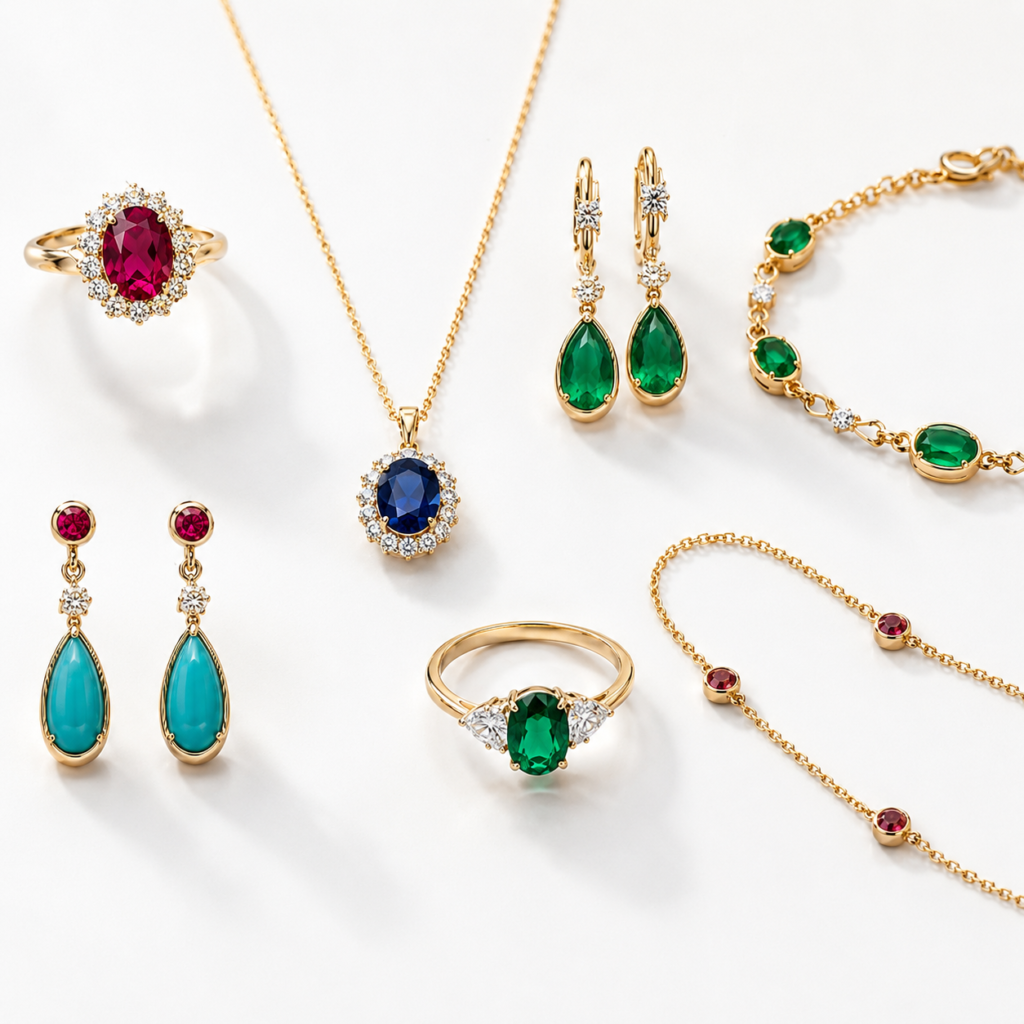
Gemstone jewellery can add colour, personality and meaning to your everyday style. However, not every gemstone is suitable for regular use. The best gemstones for everyday wear should be able to withstand frequent exposure to scratches, accidental knocks, chemicals, heat and regular cleaning. A gemstone may look beautiful, but its hardness, toughness, stability, treatments and jewellery setting all determine whether it can be worn daily. In this guide, we explain which gemstones are best for daily wear, which require extra care and how gemstone certification can help you make an informed choice. What Makes a Gemstone Suitable for Everyday Wear? Many buyers judge gemstone durability only by the Mohs hardness scale. However, hardness is only one part of a gemstone’s overall durability. Three factors determine whether a gemstone is suitable for everyday wear: A gemstone may rank high on the Mohs scale but still be vulnerable to breaking. Topaz, for example, has a hardness of 8 but can split along its cleavage direction when struck. The type of jewellery also matters. Rings and bracelets are more exposed to impacts than earrings and pendants. A delicate gemstone may therefore be suitable for everyday earrings but not for an everyday ring. Best Gemstones for Everyday Wear The following gemstones offer a strong combination of hardness, toughness and stability, making them suitable for regularly worn jewellery. 1. Diamond Diamond is one of the best gemstones for everyday wear because it ranks 10 on the Mohs hardness scale. It offers excellent resistance to scratching and surface abrasion. This makes diamond a popular choice for engagement rings, wedding rings, earrings, pendants and bracelets. However, diamonds are not unbreakable. A strong impact at a vulnerable edge or point can still cause chipping. Secure settings and regular jewellery inspections are important for diamond jewellery worn daily. Best suited for: Rings, earrings, pendants, bracelets and everyday jewellery. 2. Ruby Ruby ranks 9 on the Mohs scale and belongs to the corundum mineral family. It has excellent toughness and no distinct cleavage, making it one of the best coloured gemstones for daily wear. Rubies can withstand regular use when properly set and maintained. However, fracture-filled, cavity-filled or dyed rubies may require additional care. Best suited for: Rings, engagement rings, earrings, pendants and bracelets. 3. Sapphire Sapphire also belongs to the corundum family and ranks 9 on the Mohs scale. Its hardness, toughness and stability make it one of the best gemstones for everyday rings. Although blue sapphire is the most recognised variety, sapphires are also available in pink, yellow, green, orange and other colours. Untreated and heat-treated sapphires are generally durable. Fracture-filled or dyed sapphires may require more cautious handling and cleaning. Best suited for: Rings, engagement rings, earrings, pendants and bracelets. 4. Alexandrite Alexandrite ranks approximately 8.5 on the Mohs scale and has excellent toughness. It is also generally stable under normal wearing conditions. Its durability makes it suitable for everyday jewellery, although it should still be removed before exercise, heavy cleaning or activities involving hard surfaces. Best suited for: Rings, earrings, pendants and carefully worn bracelets. 5. Spinel Spinel ranks 8 on the Mohs scale and offers good toughness. It is available in red, pink, blue, purple and several other colours. Its durability and colour range make spinel an excellent option for buyers looking for a gemstone suitable for regular wear. Fracture-filled spinel may require different cleaning methods and should be handled carefully. Best suited for: Rings, earrings, pendants and bracelets. Gemstones Suitable for Daily Wear with Some Care Some gemstones can be worn regularly but require greater protection from scratches, impacts and unsuitable cleaning methods. Aquamarine Aquamarine ranks approximately 7.5 to 8 on the Mohs scale. It is durable enough for regular jewellery and can be used in rings, earrings and pendants. People with active lifestyles should consider a protective setting for an aquamarine ring. Best suited for: Earrings, pendants and carefully worn rings. Morganite Morganite belongs to the beryl mineral family and ranks around 7.5 to 8 on the Mohs scale. It is suitable for everyday jewellery with reasonable care. Because its light colour can show oils and dirt easily, regular gentle cleaning may be necessary. Best suited for: Earrings, pendants and rings with protective settings. Tourmaline Tourmaline ranks approximately 7 to 7.5 on the Mohs scale. It can be worn regularly but should be protected from hard impacts and extreme heat. Warm water, mild soap and a soft brush are generally safer than steam or ultrasonic cleaning. Best suited for: Earrings, pendants and carefully worn rings. Amethyst Amethyst ranks 7 on the Mohs scale. It is suitable for regular wear, particularly in earrings and pendants. Amethyst rings may develop scratches or surface wear over time, especially when worn daily. It should be stored separately from harder gemstones. Best suited for: Earrings, pendants and occasional daily-wear rings. Citrine Citrine is also a variety of quartz and ranks 7 on the Mohs scale. It can be used in daily jewellery but may gradually show scratches when frequently worn in rings or bracelets. Best suited for: Earrings, pendants and protected rings. Garnet Different garnet varieties generally range from approximately 6.5 to 7.5 on the Mohs scale. Garnet can be worn regularly, although it is more vulnerable to scratching than diamond, ruby or sapphire. Earrings and pendants usually experience less impact than rings. Best suited for: Earrings, pendants and rings with secure settings. Gemstones That Require Extra Care These gemstones can still be worn and enjoyed, but they may not be the best gemstones for everyday rings, particularly for people with active routines. Emerald Emerald ranks approximately 7.5 to 8 on the Mohs scale, but natural emeralds often contain inclusions and surface-reaching fissures. Many emeralds are treated with oil or other substances to improve their apparent clarity. These treatments can affect how the gemstone should be cleaned and maintained. Emerald jewellery should be protected from hard impacts, chemicals, heat and sudden temperature changes. Best suited for: Earrings, pendants and carefully worn rings with protective settings. Topaz Topaz
Birthstones by Month: Meanings, Colours and Benefits
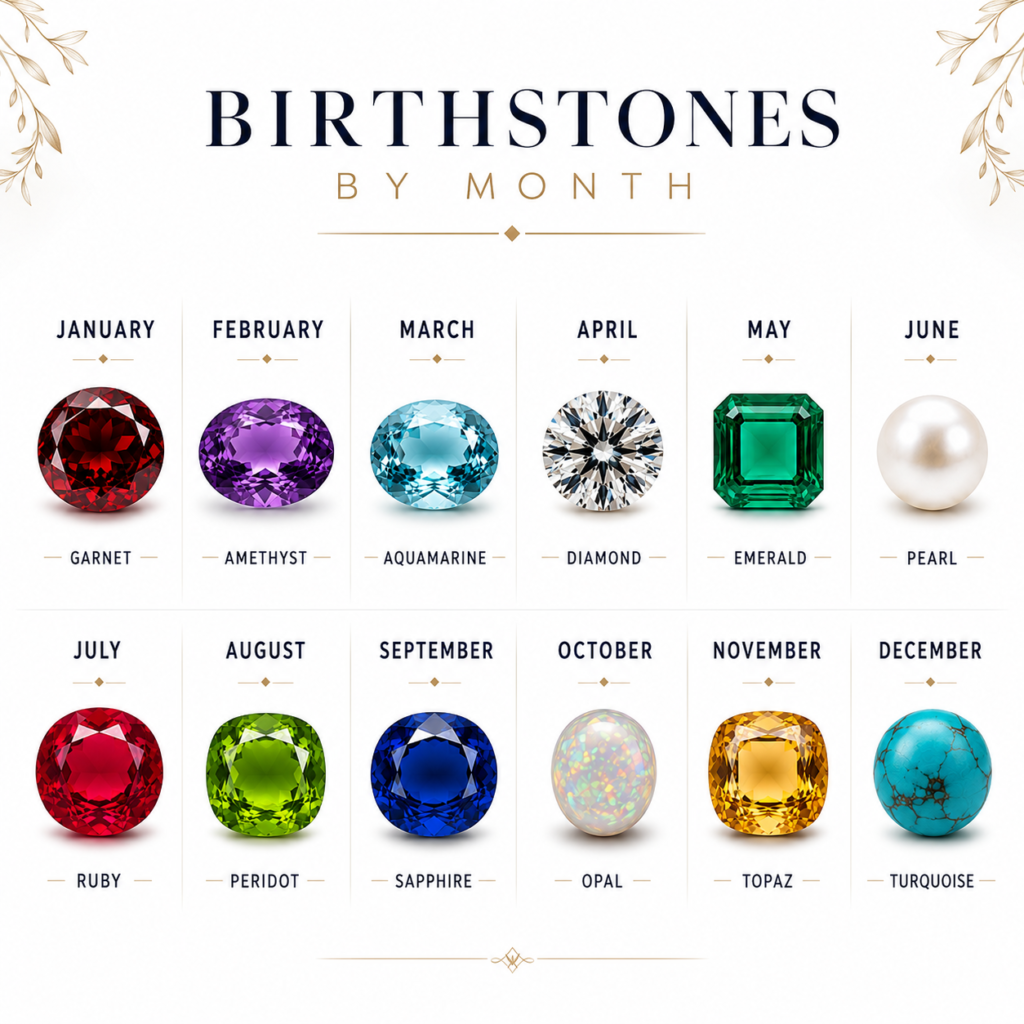
Birthstones are gemstones traditionally associated with the month in which a person is born. They are commonly worn in rings, pendants, bracelets and earrings as symbols of identity, personality and personal milestones. But birthstones were not assigned to months because of a proven scientific connection. The tradition is believed to have developed from ancient associations between 12 gemstones, the 12 zodiac signs and the 12 months of the year. The official birthstone list commonly followed by the jewellery industry was established in 1912 and has been updated over time. The benefits associated with birthstones come from history, folklore and cultural beliefs. They should not be treated as scientifically or medically proven effects. Their real appeal lies in the personal meaning they add to jewellery. Birthstones by Month Chart Month Birthstone Colour Traditionally Represents January Garnet Red, green, orange and purple Protection and commitment February Amethyst Purple Clarity and calmness March Aquamarine, Bloodstone Blue, dark green and red Peace and courage April Diamond Colourless and fancy colours Strength and lasting love May Emerald Green Growth and renewal June Pearl, Alexandrite, Moonstone White, colour-changing and iridescent Purity and transformation July Ruby Red Passion and confidence August Peridot, Spinel, Sardonyx Green and multiple colours Positivity and protection September Sapphire Blue and multiple colours Loyalty and truth October Opal, Tourmaline Multicoloured Creativity and individuality November Topaz, Citrine Yellow, orange, blue and pink Warmth and prosperity December Turquoise, Tanzanite, Zircon Blue and blue-violet Protection and new beginnings January Birthstone: Garnet Garnet became January’s recognised birthstone through historical birthstone traditions and the modern official list. It traditionally represents protection, friendship, commitment and prosperity. Garnet was once carried by travellers as a protective gemstone and was believed to promote confidence and happiness. Although deep red is its best-known colour, Garnet also occurs in vibrant green, orange, yellow and purple varieties, giving January-born jewellery buyers more choices than they may expect. Explore Garnet colours, meaning, jewellery, care and more in our complete guide to the January Birthstone: Garnet. February Birthstone: Amethyst Amethyst is February’s birthstone and has long been associated with calmness, clear thinking and emotional balance. Its name comes from the Greek amethystos, linked to the ancient belief that the gemstone helped its wearer remain clear-headed and in control. Its shades range from soft lilac to deep royal purple, making it suitable for both delicate everyday jewellery and bold statement pieces. Learn more about Amethyst colours, meaning, jewellery and care in our complete February Birthstone: Amethyst guide. March Birthstones: Aquamarine and Bloodstone Aquamarine and Bloodstone are the birthstones for March. Aquamarine’s name means “seawater”, and ancient sailors believed it offered protection during sea journeys. It represents peace, clarity, communication and harmony. Bloodstone, recognised by its dark green colour and red spots, traditionally represents strength, courage and vitality. Aquamarine suits elegant, modern jewellery, while Bloodstone is an interesting choice for buyers who prefer earthy and unconventional designs. Explore both March gemstones in detail in our Aquamarine and Bloodstone birthstone guide. April Birthstone: Diamond Diamond is April’s birthstone and traditionally represents clarity, strength, commitment and eternal love. Its exceptional hardness and ancient natural formation have made it a symbol of something valuable and enduring. Diamond jewellery is suitable for birthdays, engagements, anniversaries and future heirlooms. Buyers should confirm whether a Diamond is natural, laboratory-grown or treated, as these categories may look similar but have different origins and market values. Discover more about Diamond meaning, colours, jewellery and certification in our April Birthstone: Diamond guide. May Birthstone: Emerald Emerald is associated with May, and its rich green colour has long symbolised spring, rebirth, renewal and growth. Traditionally, Emerald represents prosperity, wisdom, hope and successful new beginnings. Its unmistakable green colour makes it a striking choice for rings, pendants and statement jewellery. Natural Emeralds commonly contain inclusions, and many are treated with oil or resin to improve their appearance, so treatment disclosure is important. Learn more about Emerald colours, meaning, jewellery, treatments and care in our May Birthstone: Emerald guide. June Birthstones: Pearl, Alexandrite and Moonstone June has three birthstones. Pearl represents purity, humility and elegance. Alexandrite, known for changing colour under different lighting, represents transformation, balance and adaptability. Moonstone displays a soft floating glow and is traditionally connected with intuition, calmness and new beginnings. Together, they give June-born buyers three very different options: timeless Pearl, rare colour-changing Alexandrite or softly glowing Moonstone. Explore Pearl, Alexandrite and Moonstone in detail in our complete June Birthstones guide. July Birthstone: Ruby Ruby is July’s birthstone, and its vivid red colour has long been associated with love, passion, power and youthful energy. It was traditionally believed to give its wearer courage, protection and success in love. Ruby is especially meaningful for romantic gifts, milestone jewellery and heirloom pieces. Since natural, synthetic, heated and fracture-filled Rubies can appear similar, their origin and treatment status should be checked before purchase. Learn more about Ruby colours, meaning, jewellery, treatments and care in our July Birthstone: Ruby guide. August Birthstones: Peridot, Spinel and Sardonyx August has three recognised birthstones. Peridot represents positivity, protection and prosperity and was historically worn as a protective talisman. Spinel represents renewal, hope and resilience and is available in colours such as red, pink, purple, blue and black. Sardonyx represents courage, stability and strength. These choices make August especially interesting for buyers seeking anything from bright green jewellery to colourful or vintage-inspired designs. Discover Peridot, Spinel and Sardonyx in our complete August Birthstones guide. September Birthstone: Sapphire Sapphire is September’s birthstone and traditionally represents truth, loyalty, sincerity and wisdom. It has been worn by royalty and religious leaders for centuries, strengthening its connection with nobility and faithfulness. Although best known in blue, Sapphire is also available in pink, yellow, green, purple, orange and white. Its durability makes it a popular choice for engagement rings and jewellery intended for regular wear. Explore Sapphire colours, meaning, jewellery and care in our September Birthstone: Sapphire guide. October Birthstones: Opal and Tourmaline Opal and Tourmaline are October’s birthstones. Opal’s changing play-of-colour has made it a symbol of
Why You Should Verify Astrology Gemstones Before Wearing Them
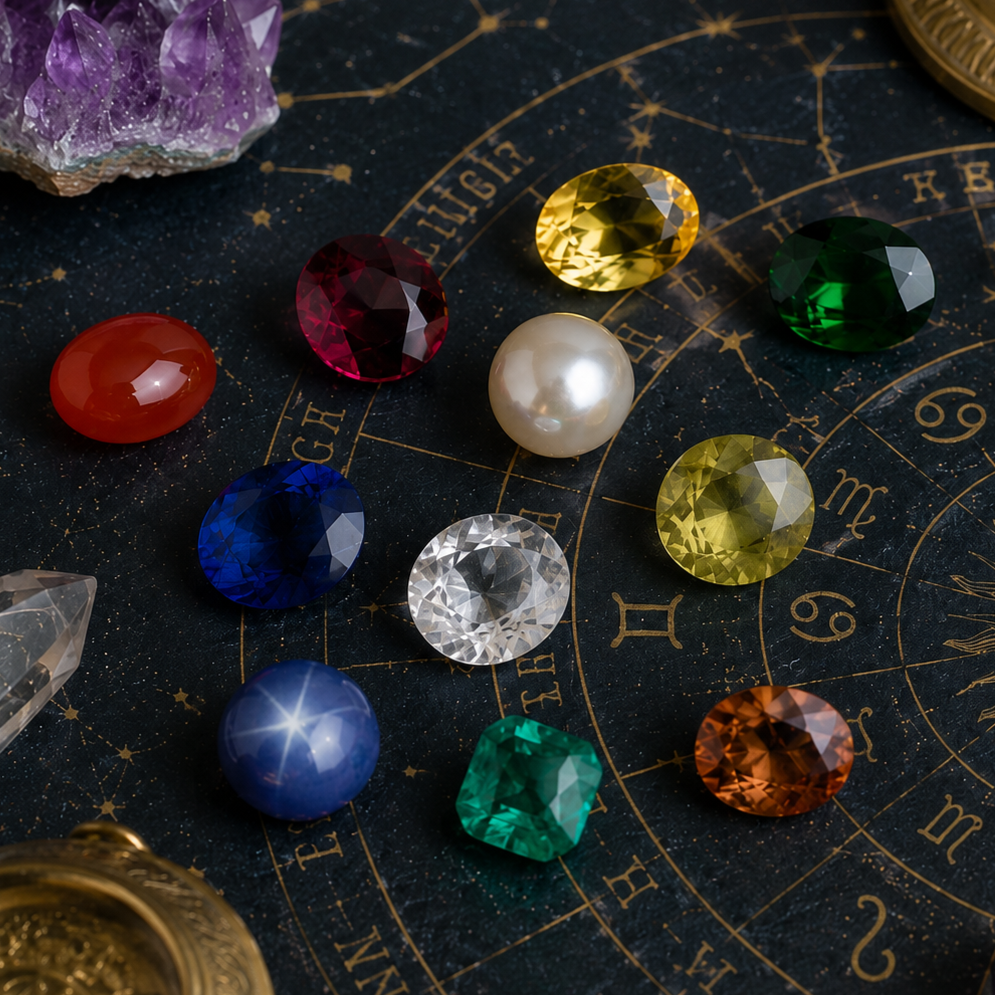
Your Astrologer Recommended a Gemstone. But Is It Really Natural? Your astrologer recommends a Yellow Sapphire (Pukhraj) for Jupiter. Or a Blue Sapphire (Neelam) for Saturn. Maybe a Ruby (Manik) for the Sun, Emerald (Panna) for Mercury, Pearl (Moti) for the Moon, Coral (Moonga) for Mars, or Cat’s Eye (Lehsunia) for Ketu. You prepare to invest in a gemstone for astrological use. But before you wear it, ask yourself one important question: How do you know the gemstone is actually natural and untreated? According to IDT laboratory data from 2026, more than 300 gemstones sold as “astrology grade” were identified as synthetic, glass-filled, or treated during testing. Most buyers cannot distinguish between: Many of these materials look nearly identical to the naked eye while having completely different origins and characteristics. This is why gemstone certification has become one of the most important steps before wearing an astrology gemstone. Whether you are buying a Yellow Sapphire, Blue Sapphire, Ruby, Emerald, Pearl, Coral, or Cat’s Eye, independent certification helps you understand exactly what you are getting. What Is Gemstone Certification? Gemstone certification is the process of examining and evaluating a gemstone in a professional gemological laboratory. After testing, the laboratory issues a gemstone certificate or gemstone report that provides information about the stone’s identity and characteristics. What Does a Gemstone Certificate Reveal? A gemstone certificate provides independent information about: For astrology buyers, this information helps verify that the gemstone matches what was promised at the time of purchase. Why Gemstone Certification Is Important for Astrology Gemstones When buying jewellery for fashion, buyers often focus on appearance. When buying gemstones for astrology, buyers usually focus on authenticity. Real Case from IDT (2026) A family in Mumbai brought a ruby to IDT after their astrologer recommended verification. The stone had been sold as a “Burma Ruby.” IDT testing revealed: Without gemstone certification, buyers may have no reliable way to verify: A certificate provides transparency and helps reduce uncertainty before the gemstone is worn. Natural, Synthetic and Imitation Gemstones: What’s the Difference? One of the most common sources of confusion is understanding the difference between natural, synthetic, and imitation gemstones. Natural Gemstones Natural gemstones are formed by geological processes in nature over millions of years. Examples include: Synthetic Gemstones Synthetic gemstones are created in laboratories but possess similar chemical compositions to their natural counterparts. They are real gemstones, but they are not naturally formed. Imitation Gemstones Imitation gemstones are materials designed to resemble genuine gemstones but may have completely different physical and chemical properties. Examples include: To the average buyer, all three categories can appear remarkably similar. That is why professional gemstone certification is essential before making a purchase. Why Treatments Matter for Astrology Many gemstones available in the market undergo treatments to improve their appearance. While some treatments are accepted within the gemstone trade when properly disclosed, they can significantly affect how a gemstone is perceived by astrology buyers. Common Gemstone Treatments These treatments can usually be detected through professional gemological testing. Many astrologers prefer natural, untreated gemstones for astrological use. As a result, buyers often seek gemstones accompanied by certification from an independent laboratory. Gaurav Issar, Founder, IDT “We see families bring stones to IDT based on their astrologer’s advice. Our job is to test whether the gemstone is natural or synthetic and whether indications of heating or other treatments are present. We report the facts so buyers and astrologers can make informed decisions.” Common Problems Found During Gemstone Testing Over 23 years and more than 15 million pieces certified, IDT laboratories have encountered many situations where gemstones were not exactly what buyers believed them to be. Top 5 Issues Identified in 2026 1. Synthetic Stones Sold as Natural Lab-grown rubies represented as natural rubies. 2. Undisclosed Treatments Yellow sapphires sold as “unheated” that showed treatment indications during testing. 3. Incorrect Gemstone Identification Blue Spinel represented as Blue Sapphire despite being a completely different mineral. 4. Simulants Sold as Genuine Gemstones Composite or glass-filled materials represented as natural emeralds. 5. Weight Discrepancies Gemstones that differed from the prescribed weight recommended by the astrologer. Most buyers do not intentionally make mistakes. They simply lack access to specialized testing equipment and gemological expertise. Gemstone certification helps bridge that gap. Would an Astrology Gemstone Work if It Is Synthetic or Treated? This is one of the most frequently asked questions among astrology gemstone buyers. Different astrologers may have different views regarding gemstone suitability for astrological purposes. However, one thing remains consistent: Most astrologers want buyers to know exactly what they are wearing. For this reason, many buyers prefer independently certified natural and untreated gemstones. Certification enables informed decisions based on facts rather than assumptions. How to Verify a Gemstone Certificate Before You Buy Receiving a certificate is important. Verifying the certificate is equally important. Before purchasing a gemstone: 1. Check the Laboratory Name Ensure the certificate has been issued by a recognized gemological laboratory. Look for: IDT Gemological Laboratories Worldwide Est. 2003 | 15M+ Pieces Certified | Official Certifiers of Miss India Crown 2. Review the Details Verify that the certificate matches the gemstone being purchased. Check: 3. Check the Treatment Line For astrology buyers, this is often one of the most important sections of the report. Look for statements such as: If terms such as the following appear, discuss them with your astrologer: 4. Verify Online Scan the QR code or visit: https://idtworldwide.com/verify Ensure that the report displayed online matches: 5. Ask Questions A reputable seller should be comfortable explaining the certificate and answering questions regarding the gemstone. If verification is discouraged or refused, consider it a warning sign. What Should You Look for in the Best Gemstone Certification in India? When evaluating a gemstone certificate, consider the following factors: Independent Testing The certificate should come from an independent gemological laboratory rather than the seller. Transparent Reporting The report should clearly disclose: Online Verification The ability to verify a report online provides an additional layer of confidence. Industry Reputation Choose laboratories with established expertise